
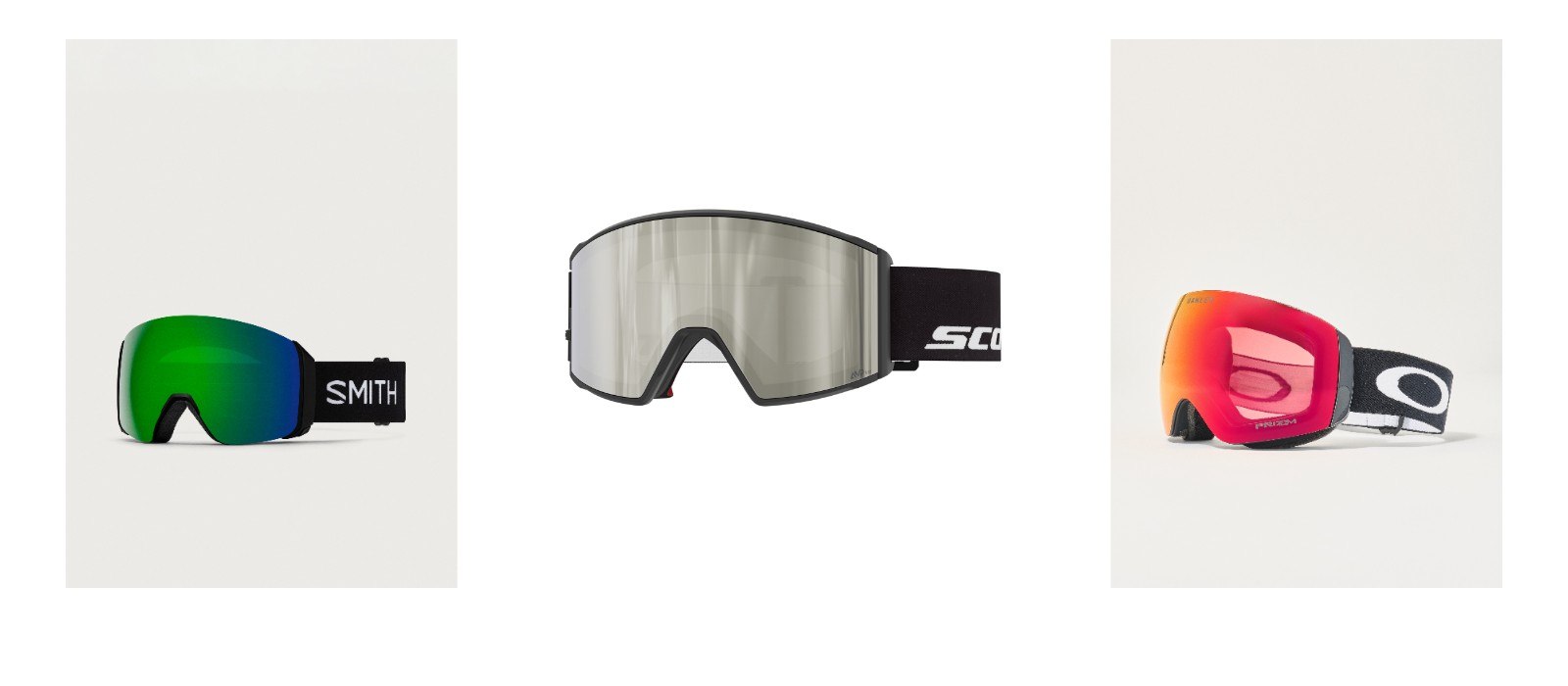
Reviewed by InTheSnow
You’ll know the feeling. The sun goes in halfway down a run, the piste turns into one flat grey sheet, and every bump comes as a surprise. Good goggles won’t make you a better skier, but they’ll stop bad light making you a worse one.
We’ve picked the best ski goggles for 2026/27, from photochromic lenses that adjust on their own to magnetic systems that swap lenses in seconds, including two SCOTT goggles we’ve reviewed in full. We update this guide every season.
Our quick picks
- Best budget: Smith Squad Photochromic (£130)
- Best value: SCOTT Ambit Light Sensitive (£140)
- Best for glasses: Smith Sequence OTG (£160)
- Best for changing light: SCOTT React (£225)
- Best photochromic: Julbo Lightyear Reactiv (£240)
- Best premium: Smith 4D MAG XL (£325)
Ski goggles 2026/27 compared
| Goggle | Price | Lens | Lens shape | Best for |
|---|---|---|---|---|
| Smith Squad Photochromic | £130 | Photochromic | Cylindrical | One lens for every condition on a budget |
| SCOTT Ambit Light Sensitive | £140 | Photochromic | Freeform | A big field of view and no lens changes |
| Oakley Line Miner L | £143 | Cat 3 | Cylindrical | Maximum field of view for less |
| Smith Sequence OTG | £160 | Photochromic, OTG | Cylindrical | Glasses wearers |
| Oakley Flight Deck M | £189 | Cat 3 | Toric | A huge, rimless view |
| SCOTT React | £225 | Magnetic, spare S1 lens | Cylindrical | Changing light, and swapping lenses with gloves on |
| Julbo Lightyear Reactiv | £240 | Photochromic, cat 0 to 4 | Spherical | A photochromic lens that covers everything |
| Smith I/O MAG | £255 | Magnetic, two lenses | Spherical | Two lenses and a quick swap |
| Anon M5 | £290 | Magnetic, bonus lens, face mask | Toric | Bad-weather days and Anon helmet wearers |
| Smith 4D MAG XL | £325 | Magnetic, bonus lens, OTG | Spherical, BirdsEye | The biggest view you can get |
How do I choose ski goggles?
Lens category. Lenses are rated from category 0 (clear, for night skiing) to 4 (very dark, for glaciers). Category 2 or 3 suits most sunny days, and a category 1 lens makes a big difference in flat light.
Photochromic or interchangeable. Photochromic lenses tint and clear on their own, so there’s nothing to change. Magnetic lens systems let you swap between a bright-light and low-light lens in seconds, and usually give you the better result at each end.
Lens shape. Cylindrical lenses are flat across your eyes and usually cheaper. Spherical and toric lenses curve both ways, giving a wider view with less distortion.
Fit with your helmet. Try them on with your helmet. There should be no gap between the two, and the strap should sit comfortably in the helmet’s goggle clip.
Glasses. If you ski in glasses, look for OTG (over the glasses) goggles, with room in the frame and channels for the arms.
The best ski goggles under £150
Smith Squad Photochromic
£130
Best for: One lens for every condition on a budget

If you only want one pair of goggles and one lens, start here. Smith’s ChromaPop Pro photochromic lens brightens in low visibility and darkens when the sun comes out, so you can concentrate on the skiing rather than swapping lenses.
It’s one of the most affordable ways to get a good photochromic lens, and a sensible first pair if you’re upgrading from hire-shop goggles.
SCOTT Ambit Light Sensitive
£140
Best for: A big field of view and no lens changes

A huge, freeform lens gives you a very wide field of view, and SCOTT’s Amplifier Light Sensitive lens combines contrast-boosting optics with a photochromic tint that darkens or lightens with the conditions.
It’s designed to be the one pair you leave on your helmet from first lift to last chair, and it suits medium to large faces best.
Oakley Line Miner L
£143
Best for: Maximum field of view for less
A streamlined frame and a large cylindrical lens that sits close to your face give you an exceptional field of view, and Oakley’s Prizm lens sharpens contrast so you can read the snow.
This version has a Prizm Sapphire category 3 lens, best for bright and mixed days rather than heavy cloud.
The best ski goggles from £150 to £250
Smith Sequence OTG
£160
Best for: Glasses wearers
Built for people who ski in glasses. A floating foam membrane takes the pressure off your temples and the arms of your glasses, and ventilation channels around the frame help it breathe and reduce fogging.
The ChromaPop photochromic lens adjusts to the light on its own, which matters more when you can’t easily take your goggles off to swap lenses.
Oakley Flight Deck M
£189
Best for: A huge, rimless view
One of Oakley’s best-selling frames every winter. The rimless design takes its cue from fighter pilots’ helmet visors, which gives you a massive field of vision, and Prizm lens technology boosts contrast.
The toric lens is compatible with glasses, and the M size suits medium faces. This version has a category 3 Prizm Torch lens for bright days.
SCOTT React
£225
Best for: Changing light, and swapping lenses with gloves on
The React’s magnetic lens system lets you swap lenses one-handed, with gloves on, and a Lens Lock keeps everything in place. SCOTT’s Amplifier lens sharpens contrast, and a spare low-light S1 lens comes in the box.
That spare lens is the bit we wouldn’t overlook. As we said in our InTheSnow review, a proper low-light lens is the difference between skiing confidently in poor visibility and crawling down. NoFog treatment, ACS venting and three-layer foam all help keep it clear.
Julbo Lightyear Reactiv
£240
Best for: A photochromic lens that covers everything
Julbo’s Reactiv lens adjusts automatically across categories 0 to 4, from night skiing and fog to the brightest glacier day, so this really is one lens for everything. The large spherical lens and frameless design maximise peripheral vision.
The magnetic SuperFlow Pro system helps keep the lens clear, which counts on warm spring days and on the way uphill.
The best ski goggles over £250
Smith I/O MAG
£255
Best for: Two lenses and a quick swap
One of Smith’s best-selling premium goggles. The MAG lens-change system is quick and easy, ChromaPop helps you see detail in the snow, and you get two lenses in the box: ChromaPop Sun for bright days and ChromaPop Storm for flat light.
The spherical lens gives a wide, clear view with little distortion.
Anon M5
£290
Best for: Bad-weather days and Anon helmet wearers
Anon’s Magna-Tech system swaps lenses in seconds, the semi-rimless frame and flat toric lens open up your peripheral vision, and there’s a bonus lens in the box.
The clever extra is the MFI face mask, which attaches to the frame with magnets to keep wind and snow off your face on the worst days.
Smith 4D MAG XL
£325
Best for: The biggest view you can get
Smith’s flagship. BirdsEye Vision gives you a noticeably bigger field of view, especially when you look down towards your skis, and the MAG system makes swapping lenses simple and secure.
A second premium lens is included, and it’s compatible with glasses. The XL frame suits larger faces.
Watch our gear reviews
Watch our ski goggles buyer’s guide
Our goggles buyer’s guide walks you through lenses, fit and the features worth paying for.
Watch the gear review playlistSubscribe to InTheSnow on YouTube
Complete your kit with our InTheSnow reviews
FAQs
What are the best ski goggles for 2026/27?
For changing light, the SCOTT React’s magnetic lenses and spare low-light lens are hard to beat. On a budget, the Smith Squad Photochromic gives you a lens that adapts on its own for £130, and for the biggest view the Smith 4D MAG XL leads the way.
What lens category do I need for skiing?
Category 2 or 3 suits most sunny days in the Alps. For cloudy or snowy days, a category 1 lens is far better. A photochromic lens or a goggle with a spare lens covers both.
Are photochromic ski goggles worth it?
If you don’t want to swap lenses, yes. They adjust on their own as the light changes, though a dedicated low-light lens is usually sharper in really poor visibility.
Can I wear ski goggles over glasses?
Yes, with OTG goggles designed to fit over glasses, such as the Smith Sequence OTG or the Smith 4D MAG XL. Standard goggles often press on the arms of your glasses.
Prices are UK prices where we have them and may change. Picks are our editorial verdict.
Specification