
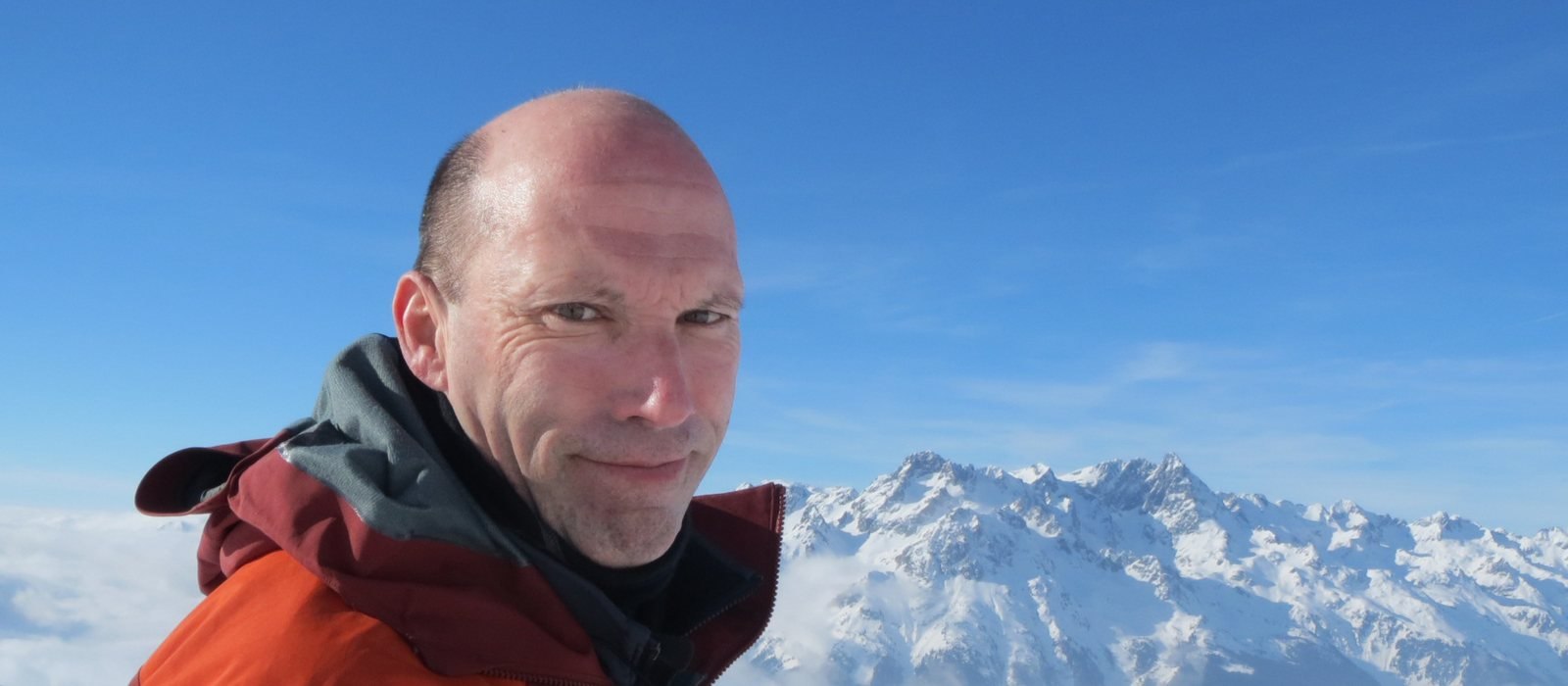
InTheSnow turns 20 this winter. Twenty winters is a long time in skiing: long enough for paper piste maps to give way to apps, for lift queues to shrink behind hands free gates, and for the glaciers to start telling a story of their own.
Few people have watched those changes as closely as our editor, Patrick Thorne, who has led InTheSnow since its first winter in 2006, and was writing about skiing long before that. With his new book, The Skiing Bucket List: 104 Ideas to Inspire Every Skier, landing just as the new season gets underway, we sat down with him to look back at what has changed, what he misses, and why he still can’t wait to get back on the snow.
If we dropped you into a ski resort in winter 2006, what would immediately make you think, “I’d forgotten skiing used to be like this”?
I think, as with everywhere, less tech! Hands free lift access was already around but a lot more resorts still had staff scanning passes and phones were a bit more basic so we were more likely to be trying to unfold a paper piste map with our ski gloves without it blowing away or getting soaking wet rather than studying a map on an app.
Have you genuinely seen the climate and snow change, or are skiers guilty of remembering every childhood winter as colder and snowier than it really was?
That is something I wonder about but when I check back what data there is is usually spot on. There were bad winters of course, just not so many, so often and, on average, the snow arrived earlier, fell and lasted for longer. But I notice the changes in the glaciers I skied the most, you’d have to be fully delusional to not see how fast they’re melting.
How have resorts responded? Are snowmaking, glacier protection, water storage and moving skiing higher things that simply weren’t part of the conversation 20 years ago?
Yes most of those things were hardly thought of 20 years ago. Snow farming is another one that’s really taking off and a lot of all-weather snowmaking machines are getting sold. There are also about 150 indoor snow centres now, about triple the 2007 total, and (in China) they’re getting bigger and bigger.
What has changed most about the actual skiing experience? How much more of a mountain can we ski in a day now?
I’m not sure we can ski that much more but faster lifts certainly help, so maybe 10-20%? It has certainly got easier and more comfortable with better gear to wear, better lifts and grooming standards ever higher, especially now slopes are visible 24/7 with webcams and social media.
Has all that efficiency cost skiing anything? Were mountains more adventurous when there were slow chairs, obscure drag lifts and places that took some effort to reach?
Yes there’s certainly some of that. We all expect the perfect conditions we’re sold on social media whenever we hit the slopes. I think we used to be more accepting of a sub-optimal ski day and just made the best of it.
What did the British skier want from a ski holiday in 2006, and what do they want now?
It was definitely more about the skiing or boarding and less about the rest back then. Even basic level accommodation is much more spacious and comfortable now and yes the big resorts have many more and better attractions from huge swimming pool complexes to zipwires, mountain coasters and viewing platforms. I’m not sure après-ski has changed very much though.
Has skiing genuinely become less affordable, or has the way we buy ski holidays changed so much that the comparison is more complicated?
Yes it is complicated. To ski more affordably, you usually have to go in the very low season, to a less well-known (cheaper) resort, and perhaps self-drive a full car or take the bus. Plenty of people do all that and get to ski for a few hundred pounds each. Most of us want a more curated experience though and that can quickly get expensive if you’re not careful.
Where is the real value in skiing today? Are there destinations British skiers routinely overlook?
We do tend to look towards the well-known resorts in the major Alpine skiing nations when, in fact, almost every country in Europe has a ski area and most are easy to get to and often cheaper. There are about 50 ski areas in the Pyrenees on the French or Spanish side for example or hundreds of ski areas in countries like Czechia, Poland and Slovakia. You can even ski in Greece.
Have modern skis and boots actually made us better skiers, or simply made skiing easier?
I think the latter, which isn’t a bad thing. In the 1990s and early 2000s there were predictions snowboarding would become more popular than skiing because it was much easier to learn at the basic level, then the arrival of carving skis saw skiing make a come back. I spent a long time learning to ski on the old long straight skis and when I tried to ski on them again recently, I couldn’t stand up.
What piece of ski technology from the last 20 years has genuinely transformed the sport?
Most aspects of skiing have got better: skiwear, skis themselves and ski boots are lighter, more functional, more comfortable. Ski lifts are also improving. I suppose it’s tech that has made the biggest leaps forward, hands free lift access is now the norm and I feel I spend less time in queues. I also like the apps that tell you which areas are getting busy in real time, so you can head to the bits of the map which aren’t.
Which resort has changed most dramatically during your time editing the magazine, and what changed?
I can think of a few that have spent hundreds of millions of Euros/pounds/dollars on new lifts transforming their ski areas. Andorra is one where once rival ski areas are now merged into the biggest ski area in the Pyrenees, Grandvalira, with everything connected by fast, comfy chairs and gondolas. Andermatt in Switzerland has also seen most of its lifts upgraded and its area expanded.
Is there a resort that understood where skiing was heading earlier than everyone else?
Well, quite a few have seen meteoric success over the past few decades. In North America you think of Vail and Whistler, although they were already well on the way as we got started. I suppose closer to home Val Thorens stands out. I remember it used to be seen as a real die-hards, skiers-only moon base type resort in the early years, but now it seems really ahead of its time, a fully rounded destination and thanks to its altitude, very snow sure.
What has disappeared from skiing over the past 20 years that you genuinely miss?
Most things have got better but I suppose as I get older I’m actually starting to miss those old double chairlifts that take 10-15 minutes to get back up the slopes, many replaced by fast quads and gondolas. It’s not just because I need a longer rest between runs these days, you used to sometimes have chance for a good chat with someone you’d never met before, that’s not so easy when the ride is over in three minutes and everyone whips out their phone.
And what used to be completely normal that makes you think, thank God we don’t have to do that anymore?
I suppose we go back to the old straight skis, although they had already gone 20 years ago, but I remember skiing powder with them in the era before the modern, snowboard-influenced, fat skis, and it was a real workout for a fraction of the fun. Again it went back in the 1990s but I do remember having to show your passport at a border crossing between Italy and France on the Via Lattea back in the early 1990s, but it was more fun than a problem.
You’ve read more ski resort press releases than almost anyone alive. What phrase immediately makes you suspicious?
Quite a few are triggering for me. “The best” usually isn’t and “luxurious” covers a multitude of sins.
What do resorts almost never talk about, but skiers actually care about?
Hmmm, perhaps lift queues? Resorts only talk about them when they announce a fast new lift is being built that will eradicate a bottleneck, rather than admitting the bottleneck exists before they build the lift.
Has social media changed ski resorts themselves, rather than just the way we talk about them?
I don’t think so. I mean you’re more likely to see selfie spots marked out on the mountain and perhaps the resort’s name written out in big letters for the same purpose, but that’s about it.
In 20 years of ski journalism, what have you changed your mind about?
Quite a lot of things. Because I have been going so long and there are so many places to see it is sometimes 10 or 20 years before I actually get round to visiting somewhere I’ve read about and formed an opinion about for years. Sometimes somewhere I thought I wanted to go turns out not to be as good as imagined. Other times way better.
In the latter category, Japan, for some reason I didn’t think I’d like. I was asked to visit and tried to get out of it, but eventually agreed to go if it was just three days. From where I live near Inverness it was 24 hours each way, flying to London, changing airports, then Tokyo, changing airports, then Hokkaido and a transfer. From the moment I landed in Tokyo I absolutely loved it. I stood bewildered looking at signs I couldn’t read and was almost immediately helped by a stranger. That was the story of the trip, lovely people, fabulous food and of course great skiing, I felt so stupid having to go back 72 hours later and came back for much longer the next year.
St Moritz was similar, I thought it would be too swanky for me, but when I got there I loved its skiing heritage, found plenty of places as affordable as the rest of the Alps. The atmosphere, skiing and snow were all great too.
How difficult was it to narrow the world down to 104 experiences for The Skiing Bucket List?
It was one of those projects that seemed a bit overwhelming at first but then came together like a jigsaw puzzle. Each of the 104 items gave me a chance to talk about different parts of whatever it was. For the steepest run for example I could discuss the different candidates and the different categories of steepness up to falling off a cliff.
After all the resorts, powder days, press trips and press releases, what still makes you want to go back?
I love snow and it hasn’t changed. It’s a magical thing how it transforms everything. I love skiing. I think it’s one of the best things mankind has invented. It instantly connects us to our childhood, pure fun and joy, forget everything else. And, yes, the nice hotels, fancy restaurants, and interesting people are all good too. Why would I ever not want to keep going back?
The book
The Skiing Bucket List: 104 Ideas to Inspire Every Skier by Patrick Thorne is out now in hardback. From the steepest runs on the planet to the experiences every skier should tick off at least once, it is 20 winters of knowledge in one place.
Here’s to the next twenty!