
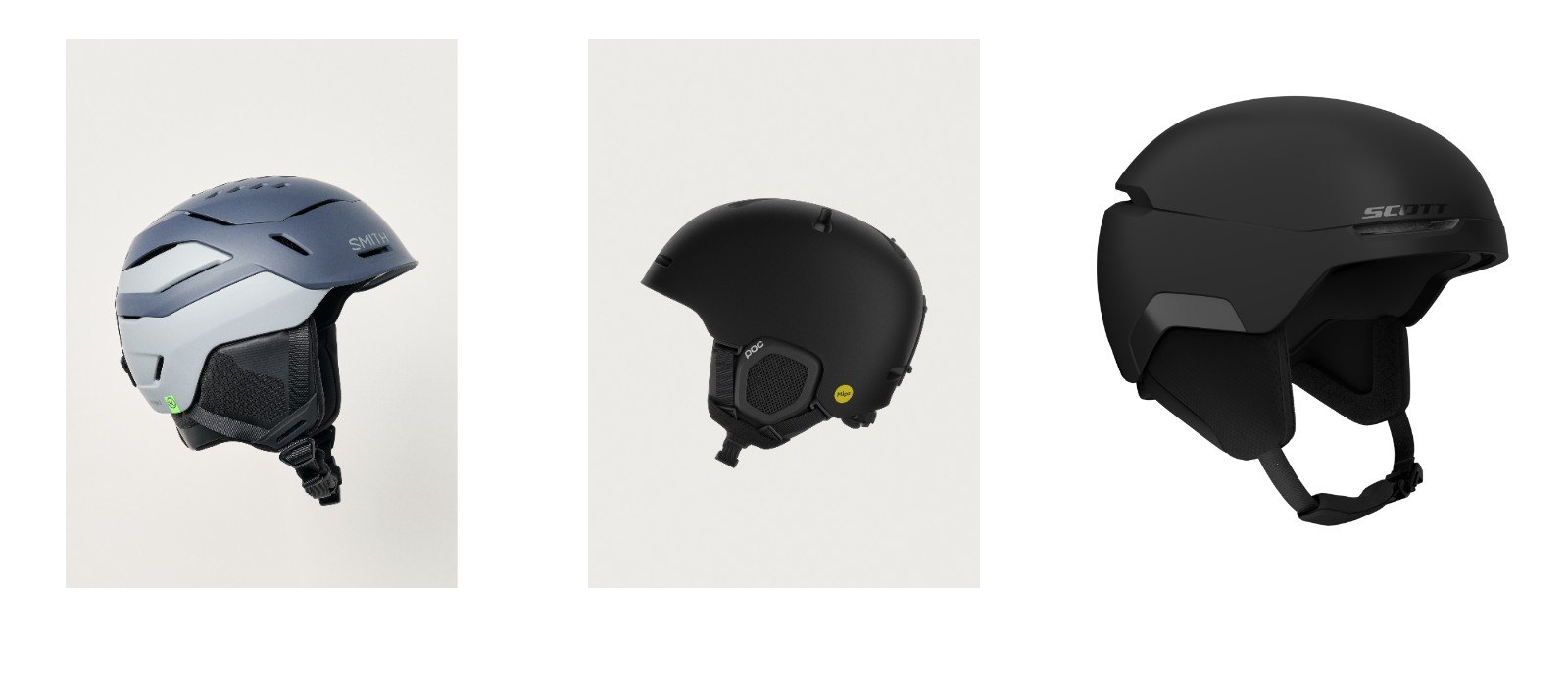
Reviewed by InTheSnow
You’ll know the moment. You catch an edge on a hard morning piste, or someone clips you in the lift queue, and you’re very glad of what’s on your head. A good helmet is the one bit of kit you hope never to test properly, so it’s worth choosing carefully.
We’ve picked the best ski helmets for 2026/27, from a £100 MIPS helmet that shrugs off the boot room to a visor helmet for glasses wearers, including two SCOTT helmets we’ve reviewed in full. Every helmet here has MIPS rotational protection. We update this guide every season.
Our quick picks
- Best budget: Giro Ledge MIPS (£100)
- Best value: SCOTT Element Pro MIPS (£130)
- Lightest: Smith Descend MIPS (£140)
- Best all-rounder: POC Fornix MIPS (£190)
- Best premium: Smith Vantage 2 MIPS (£260)
- Best visor helmet: Salomon Driver Pro Sigma Photo MIPS (£290)
Ski helmets 2026/27 compared
| Helmet | Price | Construction | Best for |
|---|---|---|---|
| Giro Ledge MIPS | £100 | Hard shell | Freestyle, and anyone who is hard on their kit |
| Salomon Pioneer 3 MIPS | £130 | In-mould | All-mountain skiers who want a low-profile look |
| SCOTT Element Pro MIPS | £130 | In-mould | All-mountain skiers who want MIPS and RECCO for less |
| Smith Descend MIPS | £140 | In-mould with Koroyd | Value with premium safety tech |
| Oakley MOD3 MIPS | £153 | In-mould | Oakley goggle wearers |
| SCOTT Flow Pro MIPS | £180 | In-mould | Freeride skiers who want every feature |
| POC Fornix MIPS | £190 | In-mould with Aramid Bridges | One helmet for piste, freeride and touring |
| Smith Level MIPS | £200 | Hybrid with Koroyd | Backcountry and big days |
| Smith Vantage 2 MIPS | £260 | Hybrid with Koroyd | Premium all-mountain protection |
| Salomon Driver Pro Sigma Photo MIPS | £290 | Visor helmet | Glasses wearers and anyone who hates goggles |
How do I choose a ski helmet?
Fit comes first. A helmet only protects you if it fits. It should sit level, just above your eyebrows, feel snug all the way round before you tighten the dial, and not rock when you shake your head. Try it on with your goggles.
Rotational protection. MIPS and similar systems are designed to reduce the rotational forces that reach your head in an angled impact. Every helmet in this guide has it, and we’d treat it as the standard now.
Construction. In-mould helmets are light and comfortable. Hard-shell helmets are heavier but tougher in everyday use. Koroyd liners add a layer designed to crumple and absorb energy.
Venting and goggles. Adjustable vents let you button up on a cold chairlift and open up on a warm afternoon, and a vent at the front helps stop your goggles fogging.
When to replace it. Replace a helmet after any significant impact, even if you can’t see damage, and check the maker’s advice on age. Most suggest every few years.
The best ski helmets under £150
Giro Ledge MIPS
£100
Best for: Freestyle, and anyone who is hard on their kit

A hard-shell helmet is tougher than most in-mould designs, which is why the Ledge is a favourite with park skiers and anyone who throws their helmet in the boot of the car. You get MIPS, front, top and rear vents, and Giro’s fit system with up to 6cm of adjustment.
The ear pads come out for warm spring days or a beanie underneath. At around 500g it isn’t the lightest, but at £100 with MIPS it’s hard to argue with.
Salomon Pioneer 3 MIPS
£130
Best for: All-mountain skiers who want a low-profile look
One of the cleanest-looking helmets at this price. MIPS helps reduce rotational forces in angled impacts, and Salomon’s EPS4D in-mould construction keeps the weight down while improving shock absorption.
It’s designed for all-mountain, freeride and piste skiing, so it suits most holiday skiers, and the low profile means it doesn’t look like a mushroom with your goggles on.
SCOTT Element Pro MIPS
£130
Best for: All-mountain skiers who want MIPS and RECCO for less

MIPS and a RECCO reflector for £130 is a rare combination. The in-mould polycarbonate shell has a tough wrap around the lower edge, where helmets usually take knocks, and SCOTT’s Active Venting System lets you open or close the vents with sliders.
Dedicated anti-fog venting pulls warm air away from your goggles, and the glove-friendly FIDLOCK magnetic buckle is a small thing you’ll appreciate on a cold chairlift. In our InTheSnow review it ticked the three boxes most of us care about: proper protection, all-day comfort and a buckle you can do up with cold hands.
Smith Descend MIPS
£140
Best for: Value with premium safety tech
Smith pairs MIPS with a Zonal Koroyd liner, a layer of tiny tubes that crumple to absorb energy in an impact, for not much more than the Element Pro. A 360° fit system and adjustable vents round it off.
At around 400g it’s the lightest helmet on this list, which you’ll notice by the end of a long day.
The best ski helmets from £150 to £250
Oakley MOD3 MIPS
£153
Best for: Oakley goggle wearers
Oakley’s flagship all-rounder pairs MIPS with a BOA fit system you tighten with one dial. It’s designed to sit seamlessly with goggles, and a front vent pulls warm air off the lens to help keep it clear.
At around 510g it’s a mid-weight helmet. It works with any goggle, but it’s at its best with Oakley’s own.
SCOTT Flow Pro MIPS
£180
Best for: Freeride skiers who want every feature
SCOTT’s freeride helmet has the lot: MIPS built into the fit system, a RECCO reflector, active ventilation and temperature-regulating padding that moves heat and moisture away as you warm up. There’s a magnetic buckle too.
In our InTheSnow review the fit felt more solid than plush and suited some head shapes better than others, so try it on with your goggles if you can. At around 500g it’s reasonable for a fully featured freeride helmet.
POC Fornix MIPS
£190
Best for: One helmet for piste, freeride and touring
POC has refined the Fornix for comfort and a better fit. Aramid Bridges reinforce the structure, MIPS helps reduce rotational forces in angled impacts, and adjustable vents let you control the airflow.
It’s rated for piste, all-mountain, freeride and backcountry skiing, which is about as versatile as helmets get, and weighs around 500g.
Smith Level MIPS
£200
Best for: Backcountry and big days
Smith’s hybrid construction balances light weight with durability, and Koroyd and MIPS work together to reduce the energy that reaches your head in an impact. The fit adjusts easily, and it’s designed with touring and backcountry days in mind.
If you split your time between the resort and earning your turns, it’s a good middle ground.
The best ski helmets over £250
Smith Vantage 2 MIPS
£260
Best for: Premium all-mountain protection
Smith’s top all-mountain helmet uses a three-piece hybrid shell to balance weight and protection, with Koroyd and MIPS to absorb and deflect energy. Adjustable vents regulate the airflow, and a micro-adjustable BOA 360° fit system keeps it secure.
At around 550g it’s not the lightest, but it’s one of the most complete helmets you can buy.
Salomon Driver Pro Sigma Photo MIPS
£290
Best for: Glasses wearers and anyone who hates goggles
A visor helmet with a difference. Salomon’s Motion Shield sits the visor closer to your face than most, so it feels as secure as a goggle, but there’s still room for prescription glasses underneath. MIPS is built in.
The photochromic visor adapts on its own as the light changes, from bright sunshine to flat light, so there’s nothing to swap during the day.
Watch our gear reviews
Watch our ski helmet buyer’s guide
Our video walks you through what to look for in a ski helmet, from fit to safety tech.
Watch the gear review playlistSubscribe to InTheSnow on YouTube
Complete your kit with our InTheSnow reviews
FAQs
What is the best ski helmet for 2026/27?
For most skiers, the POC Fornix MIPS is our best all-rounder. If you’re on a budget, the Giro Ledge MIPS gives you MIPS for £100, and the SCOTT Element Pro MIPS adds a RECCO reflector for £130.
Do I need a MIPS helmet?
MIPS is designed to reduce rotational forces in angled impacts, which are common in skiing falls. It’s now standard on most mid-range helmets, and every helmet in this guide has it.
How should a ski helmet fit?
It should feel snug all round without pressure points, sit level just above your eyebrows and not move when you shake your head. Leave no gap between the helmet and the top of your goggles.
How often should I replace my ski helmet?
Straight away after any significant impact, even if it looks fine, as the liner may be compressed. Otherwise, check the manufacturer’s guidance on age.
Prices are UK prices where we have them and may change. Picks are our editorial verdict.
Specification