Accommodation

Quick answer: Alpe d’Huez suits intermediates, families and mixed-ability groups who want a large, sunny, high-altitude French ski area with plenty of piste mileage. It is less suited to skiers looking for a small, traditional village or a quiet boutique resort.
Quick resort facts
Ski area: 250km of slopes, 111 runs, 67 lifts · Highest point: 3,330m · Longest run: 16km (Sarenne) · Season: early December to late April · Nearest airport: Grenoble (99km) · Snowmaking: 1,053 snowmakers, 27 groomers
Written by the InTheSnow editorial team. Last updated: 29 July 2026. Resort facts checked against official Alpe d’Huez sources.
Alpe d’Huez is one of France’s major high-altitude ski resorts, sitting in the Grandes Rousses massif and offering access to a large linked ski area with 250km of slopes, 111 runs and skiing up to 3,330m. It is best known for sunshine, long cruising terrain, strong intermediate skiing, good family appeal and the famous 16km Sarenne black run. For UK skiers, Alpe d’Huez is a useful all-rounder. It has the scale for a proper week on the mountain, enough easier terrain for beginners and families, plenty for intermediates, and a few famous challenges for stronger skiers. It is not the quaintest resort in the French Alps, but it is practical, sunny, high and very good at delivering the kind of ski holiday most people actually want.
Jump to: Ski Area · Skiing by Ability · Snow & Best Time to Go · Lift Passes · Getting There · FAQs
Terrain split: Of Alpe d’Huez’s 111 pistes, roughly 32% are green, 26% blue, 31% red and 12% black, a spread that favours beginners and intermediates, alongside a smaller set of well-known black runs including Sarenne.
Best for: Intermediates, families, mixed-ability groups, sunny ski holidays, long runs, high-altitude French skiing and skiers who want a big resort without necessarily going to the Three Valleys or Paradiski. Alpe d’Huez works particularly well for UK skiers who want a resort with scale, convenience and plenty of piste mileage. It is a strong choice for intermediates because there is a lot of terrain to cover, and it suits families because the resort has learning areas, a good range of accommodation and linked villages with different atmospheres. It is less ideal for skiers whose first priority is chocolate-box Alpine charm. Alpe d’Huez is practical and high rather than tiny and traditional. Some people will prefer the village feel of somewhere like Méribel or Morzine. Others will quite happily trade that for sunshine, altitude and 250km of skiing.
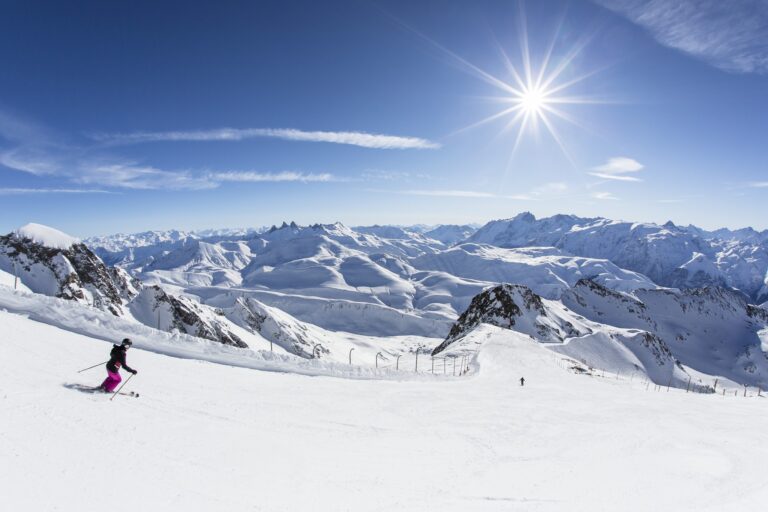
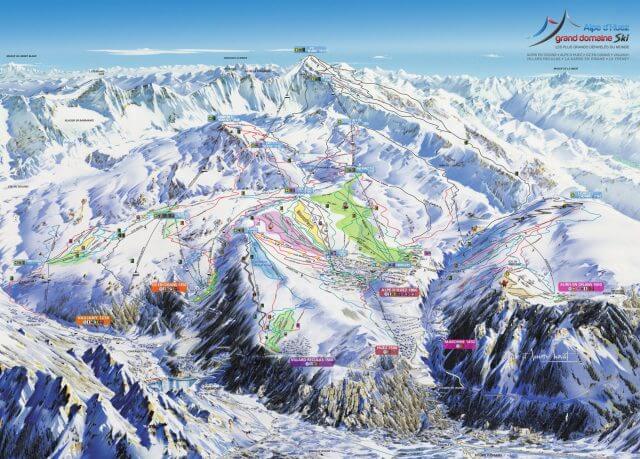
Alpe d’Huez is one of the best-known names in the French Alps. Sitting high above Bourg d’Oisans, the resort combines altitude, sunshine, long descents and a large ski area linking several villages. The official ski area brings together Alpe d’Huez, Auris-en-Oisans, Oz 3300, Vaujany and Villard-Reculas, giving visitors a choice of bases and skiing styles. The main resort of Alpe d’Huez is the busy, practical centre of the area, with direct access to lifts, ski schools, shops, restaurants and most resort services. Auris-en-Oisans has a calmer, more family-focused feel. Oz 3300 offers quick access towards the higher mountain and Pic Blanc. Vaujany adds a more traditional village atmosphere with modern lift access, while Villard-Reculas is quieter and more natural. For UK skiers, that variety matters. Alpe d’Huez can be a lively main-resort holiday, a family ski week, a quieter village-based trip, or a big-mileage intermediate-skiing holiday. It depends where you stay and how you use the ski area. The resort’s biggest strengths are obvious: high skiing, broad appeal, good lift access, long pistes and a strong sunshine record. The official resort site describes Alpe d’Huez as having more than 300 days of sunshine a year, which explains the resort’s long-standing “Island in the Sun” reputation.
© ALPE D’HUEZ TOURISME
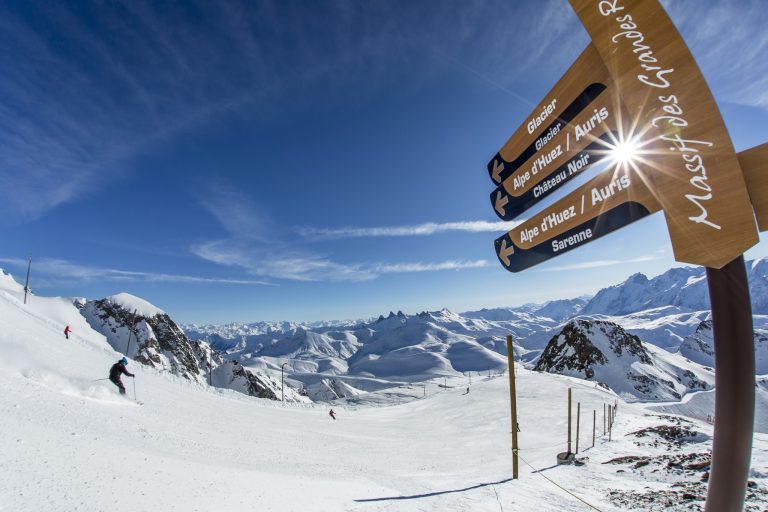
The Alpe d’Huez ski area is large, high and varied. Officially, it offers 250km of slopes, 111 runs and 67 ski lifts, with skiing rising to 3,330m. That gives the resort the key ingredients many UK skiers want from a French ski holiday: altitude, enough terrain for a week and a wide spread of piste options. The skiing is spread across the linked villages of Alpe d’Huez, Auris-en-Oisans, Oz 3300, Vaujany and Villard-Reculas. This gives the ski area more personality than it might first appear to have from the main resort alone. Alpe d’Huez is the central hub, but the outlying villages offer quieter slopes, varied views and useful alternatives during busy weeks. The high point is Pic Blanc, from where the most famous descents begin. Sarenne is the name everyone knows, a long black run often cited as one of the longest in Europe. Le Tunnel is the more technical talking point, taking skiers through an underground tunnel section before dropping onto steeper terrain. For most skiers, though, Alpe d’Huez is not about one famous run. It is about the amount of useful piste skiing available. Intermediates can cover serious ground, families can find gentler areas, and stronger skiers have enough high-mountain terrain to keep the week interesting.
Alpe d’Huez can work well for beginners, especially if they stay close to the right learning areas and avoid trying to conquer the whole mountain too soon. The resort has gentle progression terrain and enough easy skiing for new skiers to move beyond the nursery slope as confidence builds. The advantage of learning in Alpe d’Huez is that beginners are not stuck in a small satellite resort with nothing else to do. Families and mixed groups can base themselves here and still give stronger skiers access to a large ski area. That makes it much more practical than a purely beginner-focused mountain. The caution is that Alpe d’Huez is still a large French resort. Beginners should take advice from ski school, pay attention to piste grading and avoid being tempted too high before they are ready. A confident-looking blue on a piste map can feel rather different at the end of a long day when legs are tired and the light has gone flat.
Intermediates are probably the skiers who get the most out of Alpe d’Huez. The resort has the scale, altitude and piste variety that confident blue and red-run skiers usually want. It is the sort of place where you can build a proper week around covering ground, rather than repeating the same handful of runs. The linked ski area gives intermediates plenty of choice. They can ski between sectors, explore the different village areas and enjoy long, open runs that make Alpe d’Huez such a popular French resort. The sunny exposure adds to the appeal, particularly on clear days when the views open up across the Grandes Rousses and Oisans. The best approach is to use the whole area rather than staying only above the main resort. Auris-en-Oisans, Oz 3300, Vaujany and Villard-Reculas all add something different, and they help make the ski area feel more varied across a week. For UK skiers who like the idea of a large French ski area but do not necessarily want the sheer scale or price of the biggest mega-domains, Alpe d’Huez is a very sensible choice.
Advanced skiers come to Alpe d’Huez with two famous names in mind: Sarenne and Le Tunnel. Sarenne is the long black descent from the high mountain, while Le Tunnel is a more technical run with its distinctive underground tunnel section. The official ski area highlights both as signature advanced descents. Sarenne is not simply about steepness. Its length is what gives it status. At 16km, it is a proper mountain journey, and conditions can change from top to bottom. It is the kind of run that makes a resort memorable, even if many strong skiers will be more interested in snow quality than ticking off a famous name. Le Tunnel is a different proposition. It is more technical and should not be treated as a novelty route. Anyone skiing it should be confident on black terrain and aware of snow and visibility conditions. There is also off-piste and freeride potential around the higher mountain, but this should be approached properly. If you plan to ski beyond marked and open pistes, use local knowledge, check avalanche conditions, carry the correct equipment where required and make sure your winter sports insurance covers the terrain you intend to ski.
Alpe d’Huez has several useful snow-reliability advantages: altitude up to 3,330m, a large linked ski area and significant snowmaking. The official ski area information lists 1,053 snowmakers and 27 groomers, which shows the scale of the resort’s piste maintenance operation. The resort is also famous for sunshine. That is part of its appeal, but it does come with a small warning. Sunny slopes can soften, especially later in the season and lower down. In spring, it is worth following the sun and snow quality through the day rather than assuming every slope will ski the same from first lift to last. January to March is usually the key period for UK skiers looking for the best balance of snow, open terrain and holiday atmosphere. February is popular with families and school-holiday visitors. March can be excellent for sunshine and longer days, although warmer weather can affect lower and sunnier slopes. The official ski pass site lists the 2025/26 winter season as running from 5 December 2025 to 25 April 2026. As always, opening dates and lift operations can depend on weather, snow and operational conditions.
Lift passes for Alpe d’Huez should be checked before booking, especially for families, groups and peak holiday weeks. The official ski pass site lists day passes, short-stay passes, long-stay passes, season passes, pedestrian passes and cross-country options. For most UK holidaymakers, the key product will be the wider Alpe d’Huez ski area pass, giving access to the linked slopes across Alpe d’Huez, Auris-en-Oisans, Oz 3300, Vaujany and Villard-Reculas. Families and groups should check the official offers carefully, as the resort promotes family and group options for longer stays. Do not leave this as an afterthought. Lift passes are one of the bigger costs of a ski holiday, and Alpe d’Huez is a large ski area where the right pass makes a practical difference. Useful official link: Alpe d’Huez official ski passes
Planning a French ski trip? See the latest ski holiday deals and compare more resorts in our ski resort search.
Alpe d’Huez has a wide range of ski school options, including lessons for children, adults, beginners, improvers, snowboarders and more specialised coaching. The official tourist office lists ski schools and related ski services for the resort. For UK families, the practical detail matters as much as the instruction itself. Check where lessons meet, how far that is from your accommodation, whether lunch is included for children, what time lessons start and whether the ski school location suits your chosen village or sector. Alpe d’Huez is a large resort, so the right ski school meeting point can make the difference between an easy morning and a daily trudge in ski boots. During February half-term and peak French holiday weeks, book lessons early. Useful official link: Alpe d’Huez ski schools
Ski and snowboard hire should be booked in advance during peak weeks, especially for families or anyone needing specific sizes. Alpe d’Huez has a broad range of ski shops and services listed through the official resort channels. For UK skiers, the usual compromise works well here: take your own boots if they fit properly, and hire skis or a snowboard in resort. That reduces airport hassle while keeping the one piece of kit that can make or ruin the week. Stronger skiers may want to check whether performance, freeride or demo skis are available, particularly if they plan to ski Sarenne, higher terrain or venture into varied snow conditions. Beginners and families should prioritise convenience, collection location and storage over chasing the cheapest possible price.
For kit advice before you travel, see the latest InTheSnow ski gear reviews.
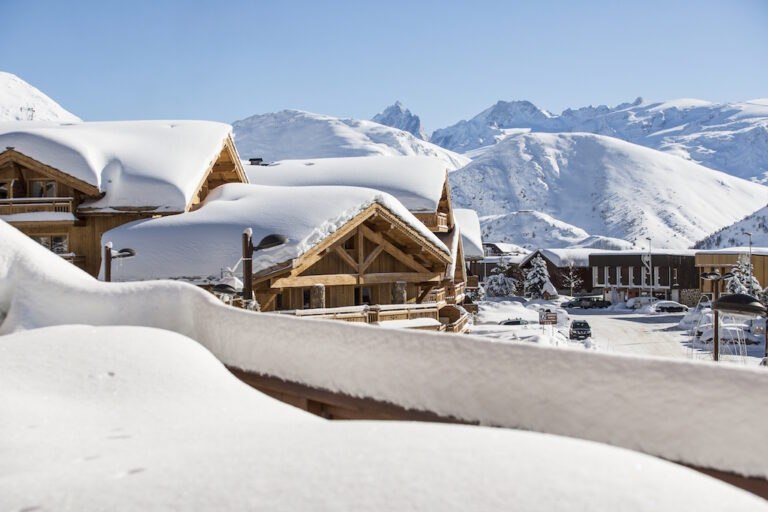
Alpe d’Huez offers a broad range of accommodation, including apartments, hotels, residences and chalet-style options. The best place to stay depends on the type of holiday you are planning. Families should prioritise proximity to ski school, beginner areas and lifts. Intermediates may want easy access to the main lift network. Groups may prefer to be closer to restaurants, bars and the livelier parts of the resort. Quieter stays may be better suited to one of the linked villages, depending on lift access and transport. The linked ski area gives visitors more choice than simply staying in the main resort. Auris-en-Oisans has a calmer, family-friendly feel. Vaujany offers more mountain-village character. Oz 3300 gives quick access to higher skiing. Villard-Reculas is quieter and more intimate. As with any large French resort, do not judge accommodation by price alone. Check walking distance to lifts, ski lockers, parking, ski school access, whether a shuttle is needed and how easy it is to get back at the end of the day. Useful official link: Alpe d’Huez official website
 Alpe d’Huez has plenty of places to eat, both in resort and across the mountain. The official ski area highlights mountain restaurants and pedestrian access to some high-altitude restaurants, which can be useful for mixed groups where not everyone skis. For skiers, lunch planning matters. Alpe d’Huez is a large ski area, and where you stop can shape the afternoon. If you are skiing across to one of the linked villages, think about whether you want to eat there, return to the main resort or stay high. In peak weeks, popular restaurants should be booked where possible. Families should also check whether lunch spots are easy to reach from ski school or beginner areas. The romantic idea of a long mountain lunch can lose some of its shine if half the group is still trying to find the meeting point.
Alpe d’Huez has enough après-ski and nightlife for groups who want a lively week, but it is not only a party resort. The main resort has bars, restaurants and evening activity, while families and quieter groups can still use it as a practical ski base. The après scene is livelier than in some smaller French resorts, particularly during peak weeks and events, but Alpe d’Huez’s real appeal is still the skiing. It is a resort where you can have a good night out, but you do not have to build the holiday around it. For specific bar and restaurant recommendations, use current official resort listings before publishing named venues, as openings and ownership can change.
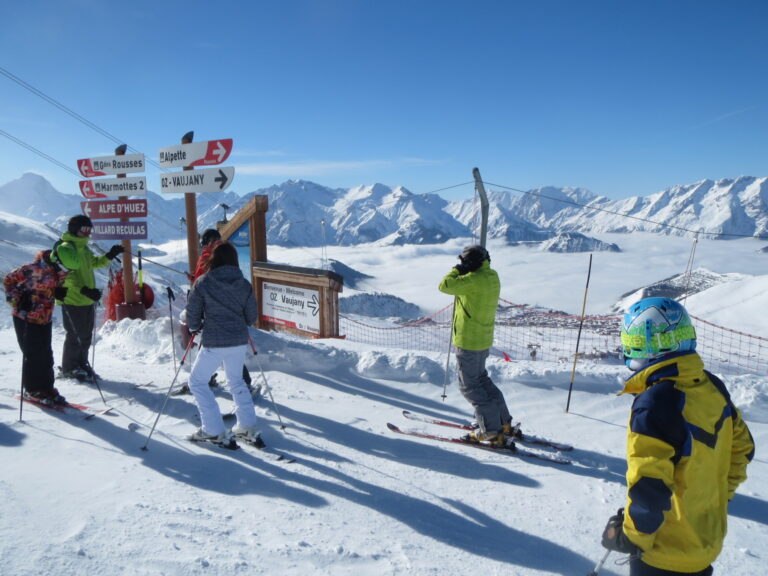 Alpe d’Huez is a strong family option because it combines a large ski area with beginner terrain, ski schools, accommodation choice and non-ski activities. The linked villages also give families different ways to approach the resort. Auris-en-Oisans is described by the official ski area as having a family atmosphere, while Vaujany is highlighted for mountain charm and family-friendly facilities. The main thing for families is choosing the right base. Alpe d’Huez itself gives the easiest access to the main resort infrastructure. Auris-en-Oisans and Vaujany may suit families wanting a quieter feel. Oz 3300 can be useful for access to the higher ski area. Before booking, check the ski school location, the distance from the accommodation to the lifts, childcare options, ski hire collection, supermarket access and how easy it is for children to get back at the end of the day. A large ski area is useful, but family ski holidays are won or lost in the morning logistics.
For more advice on choosing a resort with children, read our family skiing guide.
Alpe d’Huez offers a useful range of non-skiing activities, making it better for mixed groups and families than a resort where everything depends on downhill skiing. The official resort activity listings include winter activities such as ice skating, tubing, paragliding, spa options, snowmobiling, climbing, fitness, walking routes and family-friendly attractions. The official ski area also highlights activities including Mountain Karting, rail sledging, snowparks, fun zones, dog sledging and snowshoeing. This matters for UK families and groups with non-skiers. A bad-weather afternoon, a tired child or someone who wants a day off the slopes is much easier to manage when the resort has more to offer than simply another lift ride.
The most convenient airport for Alpe d’Huez is Grenoble-Alpes-Isère Airport, around 100km from the resort. Lyon-Saint Exupéry is another major option at around 150km, while Geneva can also work for international travellers. The official transport page also identifies Grenoble as the closest train station, with onward bus or taxi connections to the resort. For UK skiers, Grenoble is often the simplest airport when flights work, particularly for package holidays and peak winter services. Lyon generally offers more flight choice, while Geneva may be useful depending on departure airport and travel dates. By train, travel to Grenoble and then continue by bus, taxi or transfer. The official transport information lists bus and train connections via Grenoble, as well as shuttle options from Lyon and Geneva. Driving to Alpe d’Huez means heading towards Grenoble and then climbing up to the resort via the famous road from Bourg d’Oisans. The final climb is well known for its 21 hairpin bends, which are rather more enjoyable when someone else is driving after an early flight. Useful official link: Getting to Alpe d’Huez
Before booking Alpe d’Huez, UK skiers should check:
The biggest mistake is treating Alpe d’Huez as just one resort. It is really a linked ski area with several different bases, and where you stay will shape the holiday. A family based close to ski school will have a very different week from a group staying for nightlife, or a strong skier trying to make the most of the high mountain.
Pros
Cons
Alpe d’Huez remains one of France’s most useful big-resort choices. It has the altitude, the mileage and the name recognition, but it also works for real ski holidays: families, mixed groups, improving intermediates and skiers who want long days on the mountain. Its strengths are clear: 250km of slopes, high skiing to 3,330m, linked villages, sunny terrain, Pic Blanc, Sarenne and enough variety for a full week. Its weaknesses are also worth knowing. The main resort is not the prettiest in the Alps, and peak weeks can be busy. For UK skiers wanting a high, sunny French ski area with plenty of terrain, good family options and genuine intermediate appeal, Alpe d’Huez is a very strong option.
© ALPE D’HUEZ TOURISME
Yes, Alpe d’Huez can work well for beginners, especially those staying close to the main learning areas. It has beginner-friendly terrain and enough progression skiing for improvers, but nervous beginners should take care not to end up too high or on harder return routes too soon.
Yes. Intermediates are probably the strongest audience for Alpe d’Huez. The ski area is large, varied and well suited to skiers who enjoy long blue and red-style cruising across a linked French ski area.
Alpe d’Huez has some famous advanced terrain, including Sarenne and Le Tunnel. It is not only an expert resort, but stronger skiers will find plenty to enjoy, especially from the higher mountain around Pic Blanc.
Alpe d’Huez has skiing up to 3,330m and significant snowmaking across the ski area, which helps its snow reliability. Conditions still vary by season, especially lower down and on sunny slopes.
January to March is usually the strongest period for a balance of snow, weather and open terrain. February is popular with families, while March can offer sunnier skiing and slightly softer conditions.
Most UK skiers fly to Grenoble, Lyon or Geneva. Grenoble-Alpes-Isère is the closest major airport option, around 100km from the resort. Grenoble is also the closest train station, with onward bus and taxi connections.
Yes. Alpe d’Huez is a good family resort, especially because of its ski area size, beginner terrain, linked villages and non-ski activities. Families should choose accommodation carefully, particularly in relation to ski school and lift access.
Alpe d’Huez is best known for its sunny slopes, 250km ski area, Pic Blanc, the long Sarenne black run and its position as one of France’s major high-altitude ski resorts.
It depends what you want. Alpe d’Huez is particularly strong for sunny intermediate skiing, families and long cruising runs. Les 2 Alpes has very high glacier skiing and a different mountain layout. Both are major Isère resorts, but they suit slightly different ski holidays.
Get all the latest ski news, gear reviews, snow reports and unmissable features direct to you inbox with our weekly ski update.