


Accommodation

Quick answer: Val Thorens is best for skiers wanting the most snow-sure resort in the Three Valleys, a long season, and a lively, youthful après-ski scene. It’s not the resort for those wanting traditional Alpine architecture or a quiet, low-key village atmosphere.
Quick resort facts
Ski area: Les Trois Vallées – around 600km of pistes and over 160 lifts, with a local sector of around 150km and 28 lifts · Altitude: 2,300m bottom lift height, rising to around 3,230m · Ski pass area: Les Trois Vallées · Season: late November to early May · Nearest airport: Geneva (143km)
Written by the InTheSnow editorial team. Last updated: 29 July 2026. Resort facts checked against official Val Thorens sources.
Val Thorens is the highest resort in Europe, sitting at 2,300m at the head of the Belleville Valley, and one of the most snow-sure bases in the Three Valleys, the world’s largest linked ski area. Purpose-built in the 1970s, it has a lively, youthful atmosphere, a long season stretching from late November into May, and some of the most reliable high-altitude skiing anywhere in the Alps.
Jump to: Ski Area · Skiing by Ability · Snow & Best Time to Go · Lift Passes · Getting There · FAQs
Val Thorens sits at the top of the Belleville Valley at 2,300m, making it the highest resort in Europe and giving it exceptional snow reliability throughout a long season. Purpose-built and largely traffic-free, it’s a compact, ski-in/ski-out resort with a lively, sociable atmosphere that draws a younger crowd alongside families and serious skiers chasing guaranteed snow.
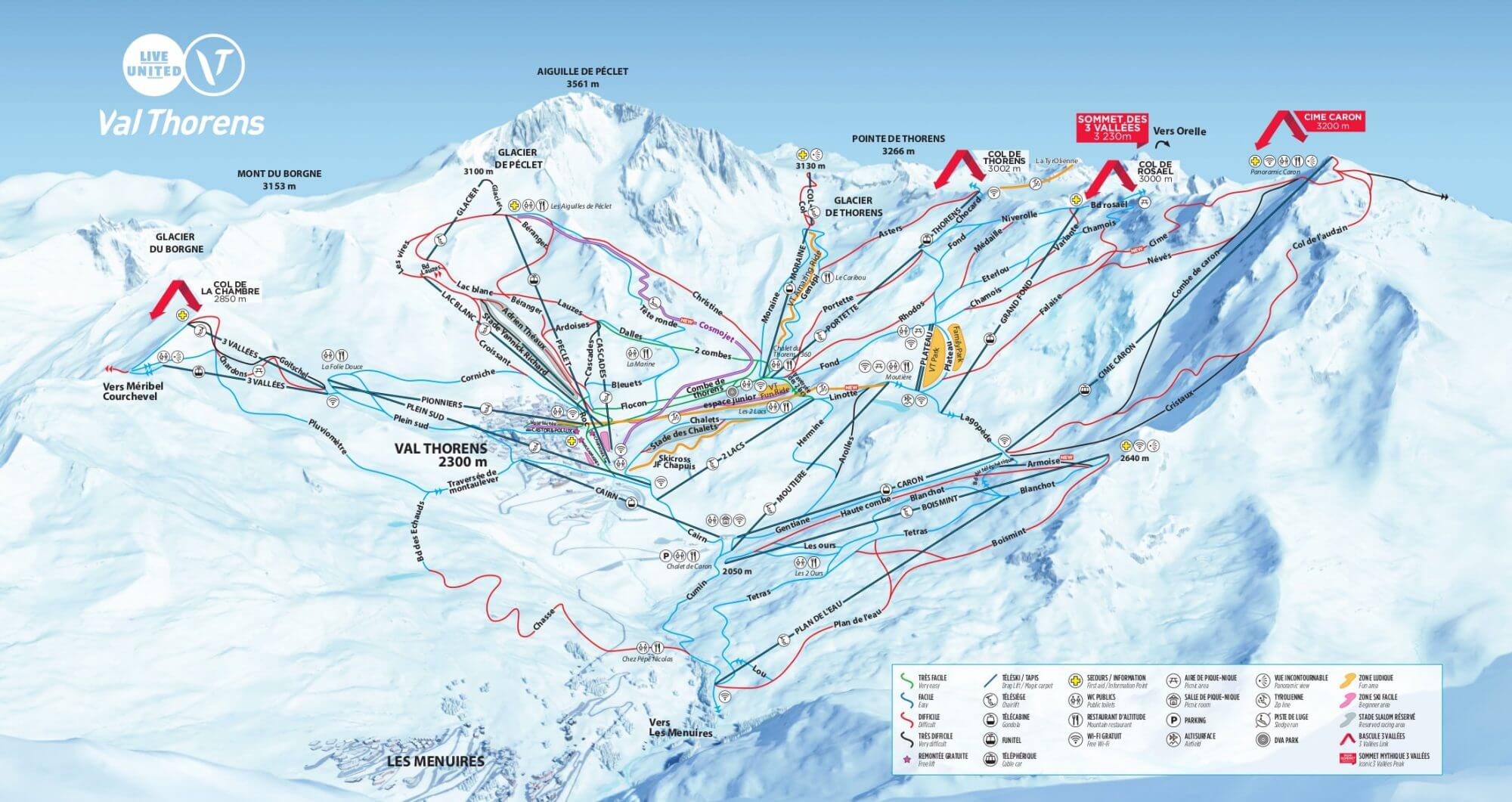
Val Thorens is part of Les Trois Vallées, the largest linked ski area in the world, with around 600km of pistes and over 160 lifts shared with Courchevel, Méribel, Les Menuires, La Tania and Saint Martin de Belleville. Its own local sector spans around 150km of pistes and 28 lifts, rising to 3,230m at the Cime de Caron, and includes the Glacier de Péclet for skiing even in poor low-altitude conditions. Snowmaking covers around 40% of the area, though it’s needed less than elsewhere given the altitude.
Comparing options for a Trois Vallées trip? See the latest ski holiday deals or browse more resorts in our ski resort search.
Beginners: There are gentle nursery slopes close to the resort centre, though the high altitude and open, exposed terrain suit confident beginners best.
Intermediates: Val Thorens offers excellent wide, sweeping pistes, particularly around the Cime de Caron and towards Orelle, plus easy access to the wider Three Valleys network.
Advanced: There’s serious terrain here, including steep pitches off the Cime de Caron, glacier skiing on the Péclet, and a well-regarded terrain park for freestylers.
Best ski-in/ski-out areas: Most of the resort, since Val Thorens was built with direct piste access throughout.
As the highest resort in Europe at 2,300m, rising to 3,230m, Val Thorens has the best natural snow reliability in the Three Valleys, with a season that typically runs longer than any other resort in the area, often from late November into early May. Average annual snowfall is around 600cm. Even in poorer snow years, the Péclet glacier provides a reliable fallback.
Lift passes cover the full Three Valleys area, giving access to Val Thorens, Courchevel, Méribel, Les Menuires, La Tania and Saint Martin de Belleville on a single pass. As a guide, adult day passes have started from around €40, with 6-day adult passes from around €190, and child prices roughly 20% lower; these are indicative and always worth confirming on the official Les 3 Vallées ski pass page before booking.
ESF and several international ski schools operate in Val Thorens, offering lessons for all ages and abilities. Ski hire shops are widespread throughout the resort, with pre-booking recommended during peak weeks given the resort’s popularity.
Sorting kit before you travel? Our ski gear guides can help you choose the right equipment.
Accommodation ranges from simple self-catered apartments to smart four- and five-star hotels and catered chalets, almost all with direct or near-direct piste access thanks to the resort’s compact, purpose-built layout.
Val Thorens has one of the liveliest après-ski scenes in the Three Valleys, with bars like La Folie Douce, Frog & Roastbeef and Malaysia drawing big crowds straight off the slopes. There’s also a good range of restaurants for those wanting a quieter evening.
Beyond skiing, Val Thorens offers an aquatic centre with pools and a spa, snowshoeing, ice diving, paragliding, and a range of ski clubs and childcare options, making it a practical choice for families as well as groups of friends.
Travelling with children? Our family skiing guide has more tips for planning a trip.
By air: Geneva is the main gateway, around 143km (roughly 2.5-3 hours) from resort. Chambéry and Lyon are also within reach. By train: Eurostar to Paris then a connecting TGV to Moûtiers, followed by a road transfer of around 45-60 minutes given the resort’s high, remote position.
Comparing Val Thorens with other options? See our full guide to skiing in France for more resorts across the Alps.
Pros
Cons
Val Thorens is the safest bet for snow in the Three Valleys, and one of the longest seasons anywhere in the Alps, making it a smart choice for early and late-season trips as well as peak winter. It particularly suits advanced skiers, groups, and anyone who wants guaranteed snow over village charm, while those craving a traditional Alpine atmosphere might prefer neighbouring Méribel. For pure, reliable skiing at altitude, it’s hard to beat.
Is Val Thorens the highest ski resort in Europe? Yes, at 2,300m it’s the highest purpose-built ski resort in Europe.
Is Val Thorens good for beginners? It can be, with nursery slopes near the resort centre, though the terrain and altitude generally suit intermediates and above better.
How high is the skiing in Val Thorens? The resort sits at 2,300m, with skiing rising to around 3,230m at the Cime de Caron.
What is the nearest airport to Val Thorens? Geneva, around 143km away, with Chambéry and Lyon also within reach.
What is skiing like for advanced skiers in Val Thorens? There’s serious terrain, including steep pitches off the Cime de Caron, glacier skiing on the Péclet, and a well-regarded terrain park for freestylers.
How long is the ski season in Val Thorens? It’s typically the longest in the Three Valleys, running from late November into early May, with average annual snowfall of around 600cm.
How much does a lift pass cost in Val Thorens? As a guide, adult day passes have started from around €40, with 6-day adult passes from around €190, and child prices roughly 20% lower.
What is the après-ski scene like in Val Thorens? It’s one of the liveliest in the Three Valleys, with bars like La Folie Douce, Frog & Roastbeef and Malaysia drawing big crowds straight off the slopes.
Is Val Thorens good for families? Yes, beyond skiing it offers an aquatic centre with pools and a spa, snowshoeing, ice diving, paragliding, and a range of ski clubs and childcare options.
Get all the latest ski news, gear reviews, snow reports and unmissable features direct to you inbox with our weekly ski update.