Accommodation


Quick answer: Mammoth Mountain suits all abilities thanks to its huge size, spring skiers wanting one of the longest seasons in North America, and anyone wanting a genuinely big Sierra Nevada mountain within reach of Los Angeles. It is less suited to those wanting a compact, walkable European-style village, since Mammoth’s base area is more spread out and car-dependent than smaller purpose-built resorts.
Quick resort facts
Ski area: Mammoth Mountain, 150+ trails, 28 lifts · Altitude: 2,424m base · Season: November to June · Nearest airport: Reno (270 miles) · Average annual snowfall: 1,016cm
Best for: all abilities thanks to its huge size, spring skiers wanting one of the longest seasons in North America, and anyone wanting a genuinely big Sierra Nevada mountain within reach of Los Angeles.
Not for: those wanting a compact, walkable European-style village. Mammoth’s base area is more spread out and car-dependent than smaller purpose-built resorts.
Mammoth Mountain rises from an ancient volcanic dome in California’s Eastern Sierra, and is one of the largest and most reliably snowy resorts in the state. Owned by Alterra Mountain Company and a founding partner of the Ikon Pass, Mammoth is famous for its huge size, high altitude and unusually long season, which regularly stretches from November into June or beyond. That volcanic origin is still visible in the mountain’s smooth, rounded profile, quite different from the jagged granite peaks typical of much of the Sierra Nevada range further north.
Jump to: Ski Area · Skiing by Ability · Snow & Best Time to Go · Lift Passes · Getting There · FAQs
The mountain’s broad, sunny bowls and huge lift network make it popular with Southern Californians for weekend trips, while its scale and terrain variety are enough to keep visiting skiers entertained for a full week. Its position away from the main Lake Tahoe resort cluster also gives Mammoth a slightly more laid-back, less crowded feel on weekdays, despite its popularity.
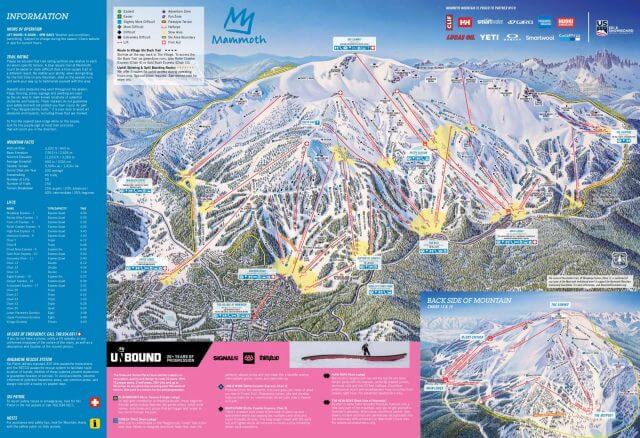
Mammoth covers around 3,500 acres across more than 150 trails, served by 28 lifts. The base sits at 2,424m (7,953ft), rising to 3,371m (11,053ft) at the summit, California’s highest ski area peak, a vertical drop of 945m (3,100ft). Average annual snowfall is 1,016cm (400 inches). The mountain’s summit, accessed by gondola, offers sweeping views across the Eastern Sierra and, on clear days, as far as the White Mountains beyond.
The mountain’s broad, open bowls near the summit offer huge, exposed terrain in good weather, while the lower mountain and tree-lined runs provide more sheltered options on stormy or windy days. Nearby Woolly’s Tube Park and a lively terrain park scene add extra variety beyond piste skiing. Unbound Terrain Parks scattered across the mountain are considered among the best in North America, drawing a strong freestyle skiing and snowboarding crowd alongside traditional piste skiers.
Canyon Lodge and the lower mountain around Main Lodge both offer gentle, well-groomed learning terrain served by dedicated lifts. Both areas are well away from faster through-traffic, making Mammoth a genuinely comfortable place for nervous beginners to build confidence.
Mammoth is particularly strong for intermediates, with wide, well-groomed cruising runs across much of the mountain and enough variety to avoid repeating terrain over several days. Runs off the Panorama Gondola and Chair 23 are particularly popular with intermediates wanting scenic, uncrowded cruising away from the busier lower-mountain lifts.
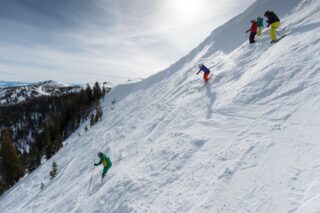
The summit bowls and steeper chutes higher on the mountain provide serious terrain for strong skiers, particularly in the days after a fresh Sierra storm. Hole in the Wall and the Dragon’s Back ridge are among the mountain’s most respected expert lines, drawing serious skiers whenever conditions allow.
Mammoth averages 1,016cm (400 inches) of snow a year thanks to its high Sierra Nevada location, and its altitude means the season often runs well into spring. January and February bring the most reliable powder, while spring visitors are drawn by Mammoth’s famously long season and generally sunny, high-altitude weather. Mammoth’s genuinely long season, often running from November into July in strong snow years, makes it one of the more flexible major resorts for planning a US ski trip around UK school holidays.
Mammoth is a founding resort on the Ikon Pass and Ikon Base Pass, alongside standalone lift tickets. Booking online well ahead of travel brings significant savings over walk-up prices, particularly on busy weekends. Ikon Base Pass holders should check current blackout dates carefully, as access during the busiest Christmas and Presidents’ Week periods can be restricted.
Mammoth’s ski and snowboard school runs extensive group and private lessons, with well-regarded children’s programmes based at Canyon Lodge. Rental shops are widely available across the resort’s various base areas and in Mammoth Lakes town. Beginner packages combining lessons, rentals and lift access are widely available and generally offer better value than booking each element separately.
The Village at Mammoth offers ski-in ski-out style lodging with a gondola connection to the mountain, while the wider town of Mammoth Lakes has a huge range of hotels, condos and vacation rentals to suit most budgets. Booking well ahead is advisable for the busy Christmas, New Year and Presidents’ Week periods, when both the Village and Mammoth Lakes town can sell out.
The Village at Mammoth has a good spread of restaurants and bars within walking distance of the gondola, while Mammoth Lakes town offers a wider, more affordable choice for evenings out. A handful of breweries and more upscale restaurants in Mammoth Lakes add further variety beyond the Village’s more tourist-focused options.
Beyond skiing, Mammoth offers snow tubing, a well-developed terrain park scene, and easy access to the wider Eastern Sierra, including Yosemite National Park’s eastern approaches once roads reopen in late spring. Mammoth’s Eastern Sierra setting also makes it a good base for combining a ski trip with hot springs, and in late spring, some of California’s most dramatic high-altitude scenery.
Most UK visitors fly into Los Angeles International Airport and drive around five hours north to Mammoth Lakes, or connect via Reno-Tahoe International Airport, roughly three hours away. Mammoth Yosemite Airport also takes seasonal flights from a small number of US cities. A hire car is strongly recommended given the resort’s spread-out base areas and rural Eastern Sierra location, with limited public transport options beyond the free local trolley system.
| Pros | Cons |
|---|---|
| Huge, varied terrain suiting every ability | Spread-out, more car-dependent base area |
| One of the longest ski seasons in North America | Long drive or limited flight options from major airports |
| Reliable, high-volume Sierra Nevada snowfall | Upper mountain can be exposed and windy in storms |
| Easy weekend access from Southern California | Can get busy on weekends with day-trippers |
Mammoth’s sheer size and reliable Sierra Nevada snow make it one of California’s most complete ski resorts, with genuine terrain for every ability and a season that regularly outlasts its Rocky Mountain rivals. It takes more effort to reach from the UK than resorts closer to a major international airport, but the scale, snow record and long season make it well worth the extra travel time. Few resorts anywhere combine Mammoth’s scale, snow record and season length so consistently, making it a genuine bucket-list destination for serious Californian and visiting skiers alike.
Yes. Canyon Lodge and the lower mountain around Main Lodge both offer gentle, well-groomed beginner terrain.
Thanks to its high altitude, Mammoth’s season regularly runs from November into June, among the longest of any major North American resort.
Fly to Los Angeles International Airport and drive around five hours north, or connect via Reno-Tahoe International Airport, roughly three hours away.
Mammoth is a founding resort on the Ikon Pass and Ikon Base Pass, operated by Alterra Mountain Company.
The resort averages around 1,016cm (400 inches) of snowfall a year, among the highest totals of any major California resort.
Get all the latest ski news, gear reviews, snow reports and unmissable features direct to you inbox with our weekly ski update.