Accommodation

Quick answer: Innsbruck suits city-break skiers who want culture, nightlife, and shopping alongside their skiing, freeriders drawn to the dramatic Nordkette, and families spreading across several gentler resorts. It is less suited to those wanting a single large interconnected piste network right outside a ski-in, ski-out chalet.
Quick resort facts
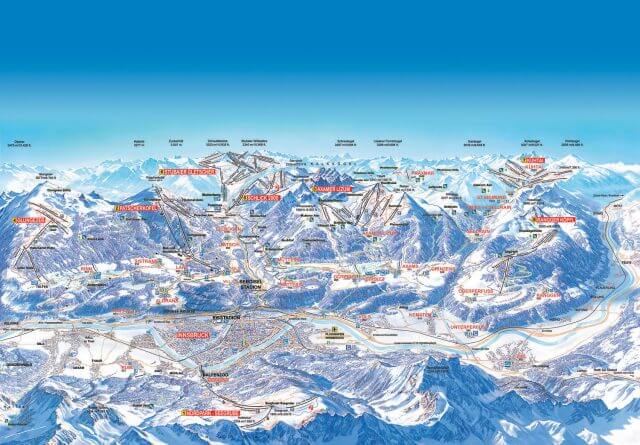
Ski area: nine ski areas including Nordkette, Axamer Lizum, Muttereralm and Stubai Glacier, 308km of pistes, 111 lifts · Altitude: 575m, skiing up to the surrounding peaks · Ski pass area: SKI plus CITY Pass · Season: November to May · Nearest airport: Innsbruck (5km)
Innsbruck is unlike any other entry in this guide: it’s a lively university city and the capital of Tirol, ringed by high mountains, with nine separate ski areas within easy reach and one of the richest winter sports pedigrees in the Alps. Innsbruck hosted the Winter Olympics in 1964 and 1976, the Winter Paralympics in 1984 and 1988, the first Winter Youth Olympics in 2012, and is set to host the 2027 Winter Deaflympics.
The Nordkette rises almost straight out of the city centre, reachable by funicular and cable car in minutes, while nearby areas including Axamer Lizum, Muttereralm, Patscherkofel, Igls, Seefeld, Tulfes, Kühtai, and the glaciated Stubai Valley add huge variety, from Olympic downhill pistes to gentle nursery slopes and glacier skiing available even in summer.
Jump to: Ski Area · Skiing by Ability · Snow & Best Time to Go · Lift Passes · Getting There · FAQs
Terrain split: spread across nine linked-by-pass ski areas, ranging from steep freeride terrain on the Nordkette to gentle family slopes at Muttereralm and Igls, plus glacier skiing at Stubai.
Best for: city-break skiers who want culture, nightlife, and shopping alongside their skiing, freeriders drawn to the dramatic Nordkette, families spreading across several gentler resorts, and anyone wanting Olympic history alongside their winter sports.
Not for: skiers wanting a single large interconnected piste network right outside a ski-in, ski-out chalet; here the ski areas are separate and reached by bus, car, or lift from the city.
Innsbruck offers a genuinely different kind of ski trip: a full city break with cafes, museums, and Old Town architecture by day or evening, and quick access to any of nine distinct ski areas by lift, bus, or short drive. It’s an especially good option for mixed groups where not everyone wants to ski every day. Browse more options in our Austrian ski resorts hub.
The Nordkette is the most dramatic and accessible area, reached via the Hungerburgbahn funicular and cable car straight from the city, with steep, freeride-friendly terrain and sweeping views over Innsbruck. Axamer Lizum hosted Olympic downhill events and offers varied piste skiing; Muttereralm is popular with families and has a dedicated carving park; Patscherkofel and Igls both have Olympic pedigree (Igls hosted the bobsleigh and luge events) and suit families and intermediates; Seefeld is world-famous for cross-country and Nordic skiing alongside its alpine slopes; Tulfes/Glungezer and Kühtai (one of Austria’s highest villages) add further variety; and the Stubai Glacier offers glaciated terrain with skiing possible even in summer months. Comparing options before you book? Our ski holiday deals and ski resort search tools make it easy to weigh up Innsbruck against other Tirol bases.
Beginners: Muttereralm, Igls, and Patscherkofel all have gentle, family-friendly slopes well suited to learning, generally quieter than the bigger freeride areas.
Intermediates: Axamer Lizum and Kühtai offer satisfying cruising terrain, with Kühtai’s altitude helping keep snow quality reliable into spring.
Experts & Freeriders: the Nordkette, Kühtai, Axamer Lizum, and the Stubai Glacier are described locally as the region’s four freeride strongholds, with steep couloirs and off-piste lines close to the city.
Nordic & Cross-Country: Seefeld is one of the best-known Nordic skiing destinations in the Alps, having hosted Olympic and World Championship Nordic events.
Snow reliability varies by area: the Stubai Glacier and Kühtai’s altitude give the most dependable cover into spring, while lower areas like Igls and Muttereralm depend more on seasonal snowfall and snowmaking. Having nine areas to choose from means it’s usually possible to find good conditions somewhere in the region across the whole winter season, and Innsbruck also offers floodlit night skiing for a different kind of ski day.
The SKI plus CITY Pass is the standout option, combining access to 12 ski resorts across the Innsbruck region and Stubai Valley with free use of public transport, entry to 23 city attractions, and one swimming pool. Visitors staying at least two nights with a partner establishment also receive the free Welcome Card, which includes free ski buses and further discounts. Current prices and full terms are on the official Innsbruck skiing page.
Each of the nine ski areas has its own ski and snowboard schools and rental shops, so visitors can choose a school suited to the terrain they plan to ski, whether that’s family-friendly Muttereralm or freeride-focused Nordkette. Booking ahead is recommended in peak weeks, and our ski gear guides are worth a look if you’re buying your own kit.
Innsbruck itself offers the full range of city-hotel accommodation from budget hostels to smart 4- and 5-star hotels, all within easy reach of the ski lifts and lift buses. Staying in the city centre suits those who want restaurants, nightlife, and sightseeing alongside their skiing, while some visitors prefer to base themselves in a quieter satellite village such as Igls.
As a city, Innsbruck has an unusually broad dining and nightlife scene for a ski destination, from traditional Tirolean taverns to modern restaurants and Old Town bars. On the mountain, expect typical Austrian hut fare, and don’t miss the novelty of night skiing under floodlights on the Nordkette, a genuinely distinctive Innsbruck experience.
Innsbruck’s city setting means there’s plenty for non-skiers and families beyond the slopes: museums, the Old Town, Christmas markets in season, ice rinks, and swimming pools (included with the SKI plus CITY Pass). The gentler ski areas such as Muttereralm and Igls are well suited to children and beginners, and the region also offers winter hiking and toboggan runs. Planning a family trip? Our family skiing guide has more advice on choosing the right base.
Innsbruck is the Alps’ best ski city break: a compact, historic capital surrounded by nine varied ski areas, from the dramatic freeride terrain of the Nordkette to the family-friendly slopes of Muttereralm and Igls, plus glacier skiing at Stubai. Add Olympic pedigree, excellent transport links including its own airport, and a genuinely different après-ski scene built around city nightlife, and Innsbruck stands out for travellers who want more than just the slopes.
Yes, the Nordkette is reached by funicular and cable car starting close to the Old Town, putting freeride terrain within minutes of the city.
There are nine main ski areas in the region, including the Nordkette, Axamer Lizum, Muttereralm, Patscherkofel, Igls, Seefeld, Tulfes, Kühtai, and the Stubai Glacier.
It’s a pass covering 12 ski resorts across the Innsbruck region and Stubai Valley, plus free public transport, 23 city attractions, and a swimming pool.
Yes, areas such as Muttereralm, Igls, and Patscherkofel offer gentle, family-friendly slopes, while more advanced skiers can head to the Nordkette or Kühtai.
Yes, Innsbruck hosted the Winter Olympics in 1964 and 1976, the Winter Paralympics in 1984 and 1988, and the first Winter Youth Olympics in 2012.
Innsbruck has its own airport with direct UK flights, making it one of the quickest ski trip transfers in the Alps; Munich is a well-connected alternative around 2 hours away by road.
Get all the latest ski news, gear reviews, snow reports and unmissable features direct to you inbox with our weekly ski update.