
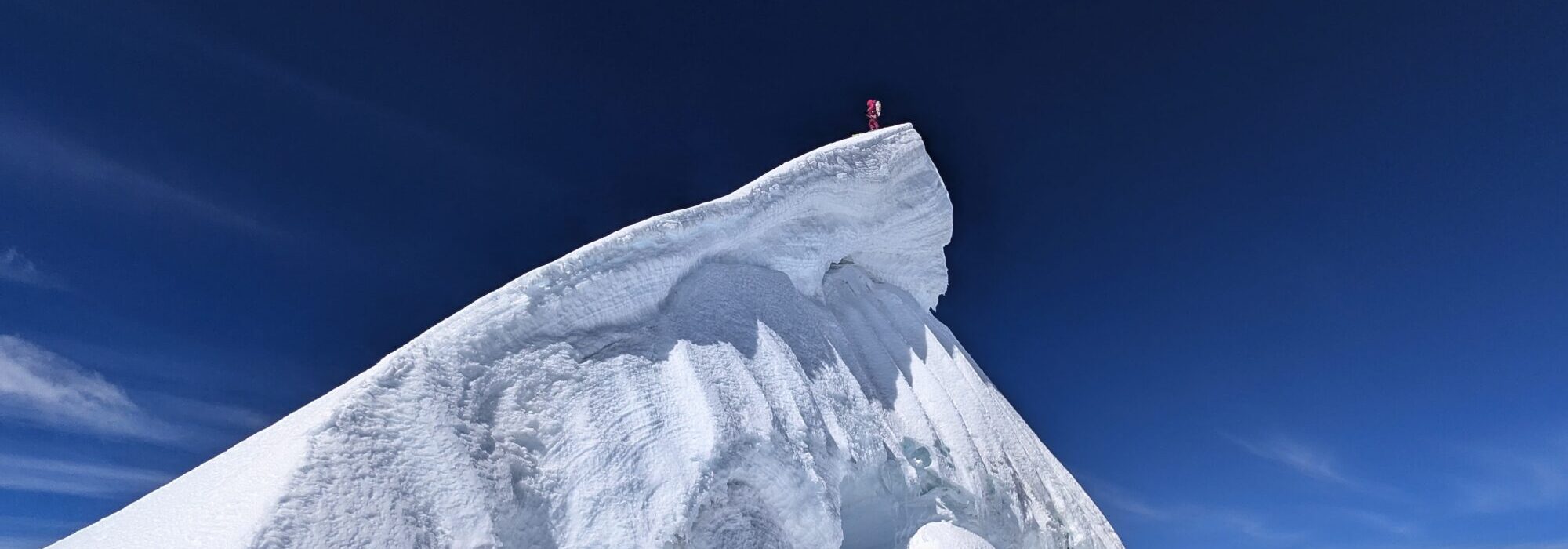
British alpinist Fay Manners, a former data consultant turned elite ski mountaineer, has completed what appears to be the first ski descent of a long‑abandoned route on the southwest ridge of Ranrapalca in Peru’s Cordillera Blanca. The line, considered inaccessible for more than 40 years due to hazardous glacial conditions, had not been climbed since 1980 and had never been skied. Huascarán National Park
Manners, originally from Bedford, undertook the expedition with Italian ski mountaineer Marco Malcangi as part of a wider project to study the region’s terrain, snowpack and future objectives. After arriving in Peru, the team began acclimatisation with a hike to 4,600 m and several days of rock climbing. Their initial plan was a straightforward ascent of Vallunaraju (5,686 m), but during the approach their attention shifted to a striking line descending from the col between Ranrapalca and Ocshapalca.

From camp, the route appeared improbably direct: a chaotic lower glacier riddled with steep crevasses and towering seracs leading into a broad, lower‑angled upper face, topped by a small, steep summit coated in spring snow. The contrast between the two sections, wild and broken below, clean and inviting above, made the line visually compelling but far from guaranteed.
“Looking upward, we weren’t sure reaching the upper slopes would be possible,” Manners said.
Curious about its history, they consulted local guide Cesar Vicuña, who confirmed the line had not been climbed in decades. He had attempted it himself in 2022 but was turned back by impassable glacial terrain. The last successful ascent was by four Swiss climbers in 1980; no known attempts had been made since, and none had ever tried to ski it.

The team returned with equipment for several days on the mountain. Manners and Malcangi carried skis and boots, while teammates hauled mountaineering gear and snow protection. Leaving camp at 4 a.m., they spent a full day breaking trail and navigating heavily crevassed terrain, establishing a safe passage through the lower section before returning to camp.
The following night, Manners and Malcangi set off for the summit push at 1 a.m., aiming to ski continuously from the summit to the glacier’s end. The ascent demanded constant adaptation: jumping crevasses, climbing squeaky névé, breaking trail through powder and crust, skinning long glacier sections, crossing fragile snow bridges and negotiating exposed terrain. At one point they made an abseil over a crevasse too large to jump, climbing awkwardly with skis strapped to their packs as they gained altitude above 6,000 m.
“The ski from the summit was spectacular but technical. Wide and open at first and then very technical with huge crevasse. The exposure was very high,” said Fay, adding, “We had to abseil down 30 metres with our skis on, and in the lower section we had to jump over crevasses on our skis without being roped. It was quite technical, and you had to be fast because the conditions were warming and becoming more dangerous.”
The ascent demanded constant adaptation: jumping crevasses, climbing squeaky névé, breaking trail through powder and crust, skinning long glacier sections, crossing fragile snow bridges and negotiating exposed terrain, the kind of high-mountain setting where avalanche safety and snowpack decision-making become as important as technical skill.
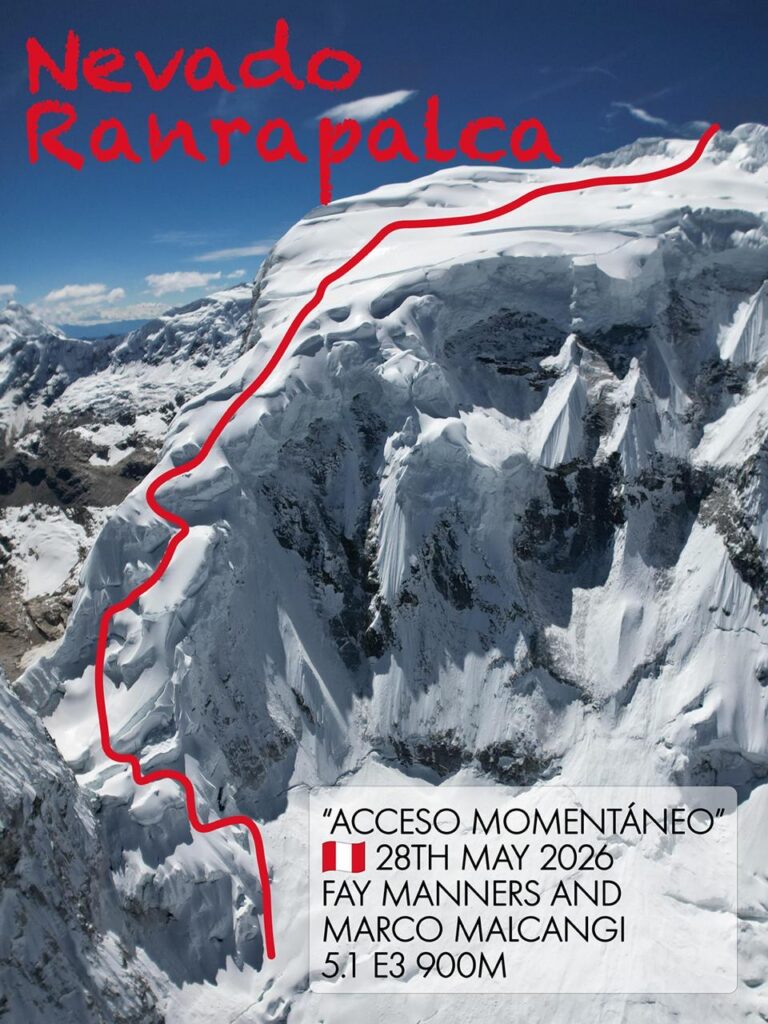
Manners and Malcangi named the route Acceso Momentáneo “Momentary Access” reflecting both the rarity of finding the line in climbable condition and the unexpected opportunity that allowed them to complete a historic first ski descent.
The North Face Athlete – Fay Manners
Who is Fay Manners?
British alpinist and ski mountaineer, originally from Bedford, now based in the Alps.
What is Acceso Momentaneo?
A 900m, 5.1 E3 ski mountaineering line on Nevado Ranrapalca, completed by Fay Manners and Marco Malcangi on 28 May 2026.
Where is Ranrapalca?
In Peru’s Cordillera Blanca, within the Huascarán National Park area. UNESCO describes the wider park as part of the world’s highest tropical mountain range.
Why was the route significant?
It appears to be the first ski descent of a line that had not been climbed since 1980, with access only briefly possible because of unusual glacial and snow conditions.