
There’s nowhere better than Austria when it comes to enjoying a great snow holiday with endless skiing and fabulous food, both on and off the mountain.
These two delights complement one another perfectly. You need plenty of hearty Austrian cuisine to fuel up for your time on the slopes, then all your exercising in the snow burns off the calories you’ve consumed, and the delicious cycle begins again!
The whole Austrian ski holiday experience is about much more than that, of course, but it is certainly a key part of what they call ‘Lebensgefühl’, an unmistakable ‘feeling of life’ that everyone who takes a ski holiday in Austria finds running through everyday moments. The feeling is carried by the people who shape your days in the mountains: warm‑hearted hosts in your hotel, inventive chefs in the restaurants and mountain huts, patient ski instructors, early‑rising lift operators, meticulous piste groomers, lively bartenders, kids’ club legends, and even the ski shop rental experts who know every boot and binding by heart. Their openness, humour and desire to help allow you to quickly connect with the people living in the resort and discover your own ‘Lebensgefühl’!
First, Let’s Ski!

Skiing in Kitzbühel © Kitzbühel Tourismus
Austria is home to some of the world’s great ski areas. Common factors include beautiful scenery, long snowy descents, state-of-the-art fast gondolas and chairlifts that get you back up to the top and quickly eat up any possible queues and, of course, many, many great mountain huts where you can take a break while enjoying the warm hospitality and wonderful food.
Kitzbühel, set deep in the heart of the Austrian Alps and home to both the legendary Streif and the world’s longest ski safari, has been crowned Austria’s Best Ski Resort at the World Ski Awards for an astonishing 13 straight years.
Its fame centres on the iconic Streif–Hahnenkamm race, a heart‑pounding course that has thrilled racers and spectators since 1966. Few ski experiences match the rush of tackling its 3.3km track with gradients of up to 85%, which anyone can try outside race periods. Or opt for a gentler alternative route that weaves around the racecourse outside event periods.
Across the wider mountain, Kitzbühel delivers sheer abundance: 90 marked pistes stretching 233km, all served by 58 modern lifts. The Kitzbüheler Hornbahn and Horngipfelbahn whisk skiers to the 2,000m summit, where early risers carve fresh black and red pistes from the Hornköpfl in peaceful, glittering solitude above the valley.
And for those craving something truly epic, the KitzSkiWelt Tour offers the world’s longest ski circuit, a remarkable 87km odyssey through constantly changing landscapes, making every turn feel like part of a grand Alpine adventure.
Skiing on the glacier ski area in Sölden, Ötztal © Ötztal Tourismus photographer Florian Kofler
Another of the big names in Austrian skiing is the Ötztal Valley, home to the well-known ski destinations of Sölden and Gurgl and famed for its snow-sure, high-altitude terrain, open from early autumn to mid-spring. It offers more than 360km of pistes served by 90 lifts across six ski areas. The Ötztal Super Skipass covers the slopes and lifts of Sölden and Gurgl, as well as the neighbouring regions of Hochoetz-Kühtai, Niederthai, Gries and Vent.
Gurgl offers a vast domain with 112km of pistes up at altitudes from 1,800 to over 3,000m, with snow guaranteed all season long and slopeside accommodation available. Nearby Sölden is home to 147km of pistes, with lifts climbing as high as 3,340m and opening up a world-class vertical of 1,990m. Its highest runs are spread across two glaciers, where the snow is so reliable that the resort is chosen to host the opening races of the annual FIS Alpine ski racing World Tour in late October each autumn.
You are never far away from fabulous food on Austrian slopes, with many experiences, like First Line at Gurgl, getting you onto the pristine fresh snow at 7.30am, but then throwing in breakfast on the mountain to enhance your perfect start to the day even more.

Harakiri piste Mayrhofner Bergbahnen Mountopolis © Zillertal Tourismus GmbH photographer Tom Klocker
Alternatively, the Zillertal region is renowned for its high‑alpine scenery and consistently deep snow, offering a spectacular backdrop as you carve down its slopes. With lifts reaching 3,250m and reliably strong piste conditions, skiing here continues well into April and, on the Hintertux Glacier, home to Austria’s longest season. Over 80% of the region’s terrain sits above 1,700m, making it one of Austria’s most snow‑secure destinations right through to spring.
As one of the Alps’ premier winter sports regions, Zillertal boasts 546km of pistes, all covered by one pass, delivering everything from gentle family runs to long, demanding valley descents. Freestyle riders can explore numerous snowparks and fun lines, while freeriders enjoy exceptional off‑piste routes.
Early‑morning corduroy sets the tone with Zillertal Arena’s Good Morning Skiing, giving skiers first tracks in the calm of sunrise every Thursday and Sunday in March. Mayrhofen’s Harakiri run delivers Austria’s steepest challenge at 78%, a fast, adrenaline‑heavy descent with big-mountain views. Freestyle riders head to Hintertux’s Betterpark, one of the Alps’ top spring and autumn snowparks, with precision‑shaped jumps and creative lines. Powder fans favour Hochfügen for its varied freeride terrain, including first‑line snowcat access to untouched slopes that make every descent feel exclusive.
The Zillertaler Superskipass, valid from early December to mid-April, covers all 546km of perfectly groomed pistes and more than 180 lift systems across the Zillertal ski areas (Spieljoch, Hochzillertal-Kaltenbach, Hochfügen, Zillertal Arena, Mayrhofen Bergbahnen – Mountopolis, and Ski & Glacier World Zillertal 3000), as well as the valley ski bus network.
Now, Let’s Eat!
Dining in the Gurgl ski area, Ötztal © Ötztal Tourismus photographer Roman Huber
As we’ve said, fabulous food is the norm across Austrian ski slopes, and some resorts score particularly highly.
The Zillertal’s appeal runs well beyond its exceptional winter sports reputation. The valley has built a strong foodie identity, developed from centuries-old culinary traditions and shaped by mountain restaurants, traditional inns and a growing roster of acclaimed gourmet venues. The region is home to around 80 gourmet huts across its ski areas, along with many award-winning gourmet restaurants in the valley.
For locals, regional produce remains central. Cheese made from local pure hay milk, bread baked to long-established recipes, and meat sourced from village butchers or nearby farms form the backbone of everyday cooking. Wild berries and meadow herbs add seasonal character, reflecting a philosophy that values local ingredients while staying open to new influences. Visitors can explore this heritage not only in restaurants and ski huts but also through the valley’s working showcase businesses.
Stopping off in the Zillertal © Zillertal Tourismus GmbH photographer Flo Smith
In Kitzbühel, culinary pleasures are everywhere, with more than 60 mountain huts and award‑winning restaurants serving distinctive, memorable dishes to choose from. Whether you’re drawn to comforting Austrian classics or refined international cuisine, the food culture here is as varied and enticing as the landscapes that surround it.
Culinary winter moments © Kitzbühel Tourismus
Across the town and up on the slopes above, the dining experience blends fine cooking, atmosphere and mountain character. With views stretching from the historic centre to Schwarzsee and the high pastures, you’ll find everything from hearty Tyrolean favourites to globally recognised gourmet restaurants, providing a culinary scene shaped by place as much as by flavour.
It’s a very similar story on the high-altitude slopes of the Ötztal Valley, where the villages of Gurgl and Sölden are not only known for winter holidays at the highest level and those extensive snow-sure slopes, but also for pairing the experience with high-end hotels and first-class dining.
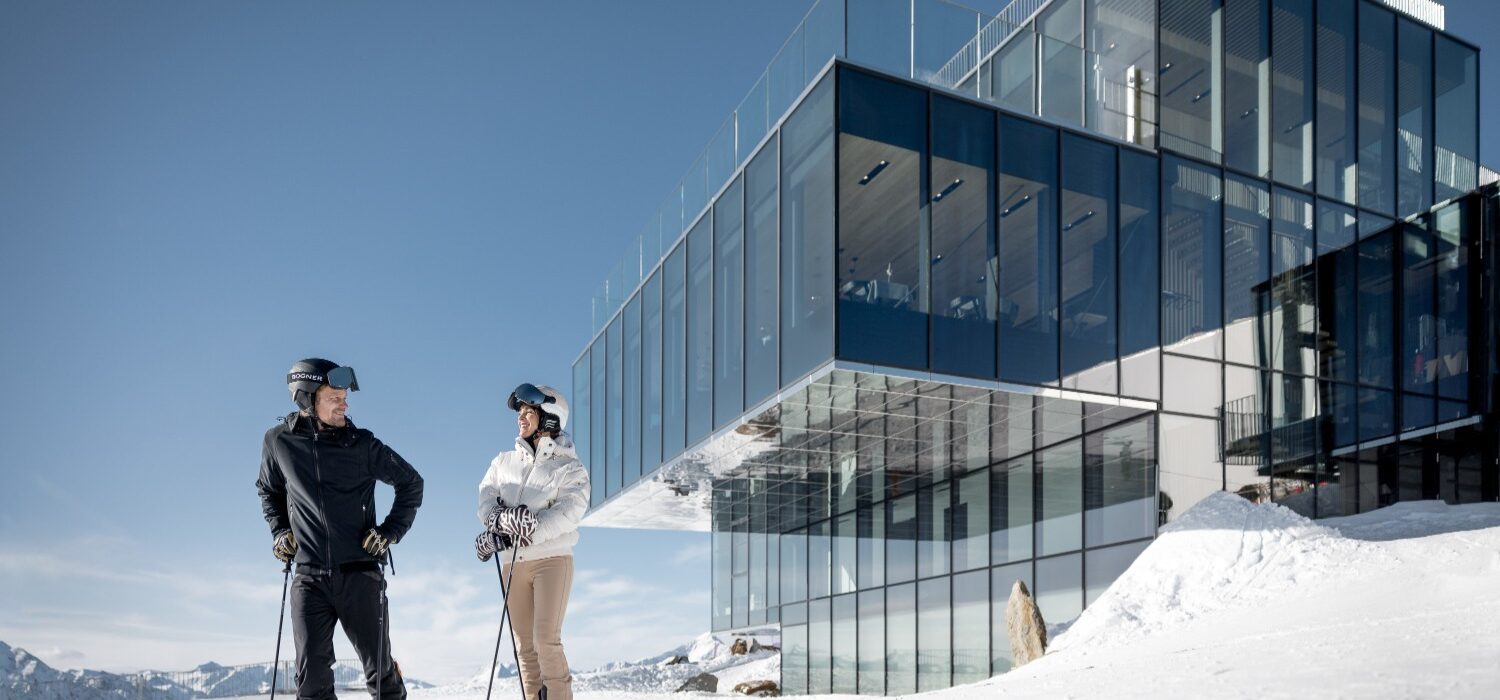
Besides dozens of fabulous mountain huts and restaurants, the region is home to some of the most visually spectacular, high-altitude, modern architectural marvels, such as the amazing ice-Q restaurant above Sölden and Gurgl’s Top Mountain Star. Both are located at more than 3,000m above sea level and are quite something to view from outside, or to dine within and look out from.
Top Spots
There are many amazing spots to choose from on Austria’s ski slopes, most of which can be accessed with or without skis, although either way you may want to reserve your table, as each is in high demand.
Ice Q at the Gaislachkogl adventure mountain, Sölden © Ötztal Tourismus photographer Rudi Wyhlidal, Architektur Obermoser arch-omo
The stunning glass-walled ice Q, a gourmet restaurant on the Gaislachkogl above Sölden at 3,048m, which features as a clinic in the Bond movie Spectre, is Austria’s highest-altitude gourmet restaurant and almost certainly its most spectacular. Up here, you’ll find not just haute cuisine, fine wines from Austria’s highest cellar and tapas, but amazing views too.
wIn Gurgl, the Hohe Mut Alm (2,670m), with its sun terrace and stunning views of Gurgl’s glaciers, brings new meaning to the term ‘haute cuisine’. From here, there are views of 21 peaks above 3,000m, which you can be inspired by as you enjoy fabulous food, perhaps from a table on the large sun terrace if conditions are good. Or try the Festkogl Alm (2,668m), which can be reached in just nine minutes by gondola from the village by non-skiers.
Skiing in Gurgl Ötztal © Ötztal Tourismus photographer Roman Huber
Gurgl is also home to the remarkable Top Mountain Star on the Wurmkogel (3,030m), which offers views out over the Ötztal Alps as far as the Dolomites and a 360-degree panorama bar. This architecturally stunning building also has a surrounding walkway, which is a popular spot for marriage proposals.
For a dining experience like no other, the Perrier-Jouët Gondola of Indulgence offers a truly exclusive experience: fine drinks and specialities from the Top Mountain Crosspoint restaurant in Gurgl are served as you ascend in a cabin on the Kirchenkarbahn lift.
Top mountain huts on Kitzbühel’s slopes offer atmosphere, views and standout cuisine. The Sonnenrast pairs a welcoming hut feel with a wide sun terrace, panoramic mountain scenery and regular live music. Sonnbühel, one of the Alps’ most iconic hut restaurants, serves refined dishes in a stylish, high‑alpine setting. Or, for some blissful tranquillity, BichlAlm sits in peaceful seclusion high above town, ideal for switching off.
Exterior Bichlalm hut in Kitzbühel in winter © Kitzbühel Tourismus
One of the best-known foodie stops in the Ziller Valley is the Erlebnissennerei Zillertal in Mayrhofen, where guests can learn how hay milk is processed and sample cheeses and yoghurts along the way at Austria’s first show dairy, a popular outing for families.
Another highlight is the WhiteLounge SnowBar on Mount Ahorn, which offers a laid‑back chillout zone on a sunny plateau, framed by striking mountain scenery and ideal for taking a breather between laps. Perfectly groomed slopes nearby invite smooth carving, while the gentle terrain around the plateau provides welcoming conditions for beginners.
Several MICHELIN stars underscore the exceptional dining standards found throughout the Zillertal. Adding to this, Guat’z Essen in Stumm has earned a MICHELIN Green Star, a distinction reserved for restaurants demonstrating outstanding sustainability in their operations. The Wiesenalm sits in the heart of the Zillertal Arena, directly beside the Rosenalmbahn and Karspitzbahn mid‑station, making it a convenient stop at both the start and end of a ski day. House favourites such as the Wiesenbier and the Wiesenfleck are standout specialities and well worth trying.
Stopping off in the Zillertal © Zillertal Tourismus GmbH photographer Flo Smith
The Stieralm on the Penken mountain above Mayrhofen offers some modern, cool ambience, with a contemporary Alpine setting, a spacious dining area and a strong commitment to quality. Carefully prepared regional specialities are paired with a thoughtful wine list. A standout feature is the organic beef from the hut’s own Angus herd, a signature element of its kitchen.
Together, these mountain huts and visitor experiences show how deeply food and drink are woven into the individual identities of leading ski villages, and why Austria continues to stand out as one of the Alps’ most engaging culinary nations.
Overall, Austrian skiing perfectly pairs world‑class terrain with equally impressive cuisine, and nowhere is this more evident than in Kitzbühel, the Ötztal and the Zillertal. Across these regions, skiers can expect high‑quality dining that blends traditional Alpine flavours with modern, creative cooking. From stylish piste‑side restaurants to rustic huts serving regional specialities, the focus is always on fresh ingredients, warm hospitality and memorable mountain settings. Whether enjoying gourmet dishes in Kitzbühel, innovative menus in the Ötztal or farm‑driven cuisine in the Zillertal, food becomes an essential part of the ski experience, elevating every day on the slopes into something truly indulgent.
For more information visit: Austria.info
Main Image ©Ötztal Tourismus_photographer_Florian Kofler, Architektur Obermoser arch-omo