
A jacket can tick every technical box and still be the wrong jacket if it doesn’t fit you and the way you layer. Fit isn’t vanity here. It decides how warm you stay, how freely you move and how quickly the garment wears out.
How should a ski jacket fit?
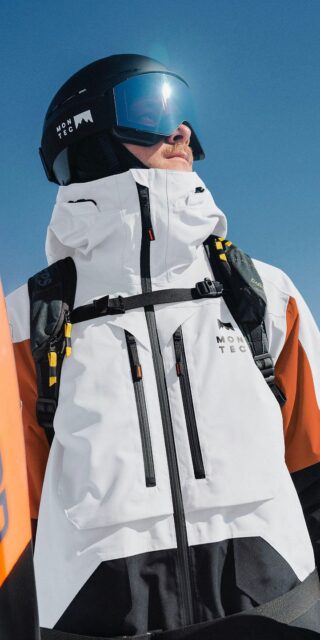
Try it on over the layers you’ll actually wear: a base layer and a mid layer at the very least. Then move. Reach forward as if planting a pole, lift your arms above your head, crouch, twist. The hem shouldn’t ride up past your waistband, the cuffs should still cover your wrists and the back shouldn’t pull tight across the shoulders.
Too tight and the fabric is under constant tension, which strains seams and the tape that seals them. Too loose and you lose warmth, catch on things and end up with fabric flapping in the wind. Somewhere in the middle is a jacket that will last.
What do waterproof and breathability ratings actually mean?
- Waterproofing is usually given in millimetres (a hydrostatic head figure). Higher means more resistance to water being forced through the fabric. For most resort skiing in the Alps, a mid-range figure is plenty. The highest numbers earn their keep in wet, maritime snow and long days out in bad weather.
- Breathability is usually given in grams (how much moisture vapour can escape through a square metre of fabric over 24 hours). The harder you work, the more this matters.
- Seam taping matters as much as either number. A brilliant fabric with untaped or partly taped seams will still let water in at the stitching.
Testing methods vary between brands, so treat the figures as a rough guide rather than a league table.
Is more technical always better?
No. A top-end three-layer hardshell is superb in the right hands, but it can feel stiff, rustly and cold on a gentle piste week, and it’s a lot of money for features you won’t use. A well-made two-layer or insulated jacket matched to how you ski will often be more comfortable and just as long-lived.
Which features are actually worth paying for?
Some features earn their place every single day. Others mostly earn their place on the swing tag.
- A helmet-compatible hood. If it won’t go over your helmet, it will spend the whole week rolled up in the collar.
- Pit zips. Underarm vents let the heat out when you’re working hard, so you’re not stopping on the side of the piste to peel off a layer.
- A powder skirt, if you ski off-piste or fall over a lot (no judgement here). It stops snow going straight up your back.
- A lift pass pocket on the sleeve or lower chest, so you’re not wrestling with a zip at every barrier.
- Long, adjustable cuffs or wrist gaiters that seal properly over your gloves.
Beyond that, be a little sceptical. Every extra zip, vent and stretch panel is one more thing that can wear or break, and you pay for all of them whether you use them or not.
The takeaway
Buy the fit first, then the specification. A jacket you’re comfortable in is a jacket you’ll keep wearing.
Frequently asked questions
Should a ski jacket be tight or loose?
Neither. It should fit comfortably over a base layer and a mid layer, and let you reach, crouch and twist without the hem riding up or the back pulling tight across your shoulders.
What waterproof rating do I need for a ski jacket?
For most resort skiing in the Alps, a mid-range rating is plenty. The highest ratings are worth having if you ski in wet, maritime snow or spend long days out in bad weather. Fully taped seams matter just as much as the number.
What does breathability mean on a ski jacket?
It’s how much moisture vapour can escape through the fabric, usually given in grams per square metre over 24 hours. The harder you work, the more it matters.
Keep reading in Buy Less, Ski More