Accommodation

Quick answer: Garmisch-Partenkirchen suits skiers wanting Germany’s premier winter sports town with genuine Olympic and World Cup ski jumping heritage, those wanting a cosmopolitan base with rich history, culture and traditional Bavarian character, and anyone keen to ski Germany’s highest peak, the Zugspitze. It is less suited to those wanting a huge, varied ski area to explore for a full week.
Quick resort facts
Ski area: around 64km of piste, 33 lifts (20 drag, 6 chair, 7 high-capacity) · Altitude: base 720m, lifts rising over 2,100m up the Zugspitze · Ski pass area: Top Snow Card / Happy Ski Card · Nearest airport: Munich (140km) · Season: November to May
Garmisch-Partenkirchen is Germany’s undisputed winter sports capital, sitting just a short distance from the Austrian border in the country’s southwestern corner. Famous for its televised New Year ski jumping competition and as a former Winter Olympics host, it’s a large, cosmopolitan town with plenty to see and do both on and off the slopes. The town formed from the 1935 merger of the two neighbouring villages of Garmisch and Partenkirchen, ahead of hosting the 1936 Winter Olympics, and both halves retain a distinct character worth exploring.
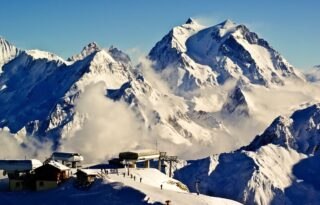
The town is rich in history and culture: local people often dress in traditional Bavarian styles without any tourist-board encouragement, and many older buildings are decorated with centuries-old frescoes. All around is magnificent mountain scenery dominated by the mighty Zugspitze, Germany’s highest peak, to which lifts rise over 2,100m from the town – producing one of the world’s biggest lift-served verticals, even if it isn’t possible to ski all the way back down.
Jump to: Ski Area · Skiing by Ability · Snow Reliability · Lift Passes · Getting There · FAQs
Terrain split: gentle runs around the lower slopes for beginners; broad cruising across the Garmisch-Classic and Zugspitze areas for intermediates; steeper pitches and the high-altitude Zugspitze terrain for advanced skiers.
Best for: skiers wanting Germany’s premier winter sports town with genuine Olympic and ski jumping heritage; those wanting a cosmopolitan base rich in history and traditional Bavarian culture; anyone keen to ski Germany’s highest peak, the Zugspitze.
Not for: those wanting a huge, varied ski area to explore over a full week, as Garmisch’s 64km is modest by Alpine standards; skiers seeking a quiet, low-key village rather than a large, bustling town.
Garmisch-Partenkirchen’s ski area covers around 64km of piste across 33 lifts, including 7 high-capacity lifts, split mainly between the Garmisch-Classic area and the high-altitude Zugspitze glacier terrain. Lifts rise more than 2,100m up the Zugspitze itself, Germany’s highest mountain, giving one of the biggest lift-served verticals anywhere in the world. A cable car and cogwheel railway both reach the Zugspitze summit, offering a scenic and relatively gentle way up for skiers and sightseers alike.
The Top Snow Card and Happy Ski Card lift pass systems also open up nearby areas across the wider region, giving visitors extra flexibility to explore beyond the resort’s own 64km on a longer stay.
Beginners have gentle runs on the lower slopes with a solid ski school infrastructure. Intermediates have broad, well-groomed cruising across the Garmisch-Classic area, with enough terrain to fill several days.
Advanced skiers should head up to the Zugspitze’s high-altitude terrain, where the dramatic vertical and glacier conditions offer a genuinely different character from the lower resort slopes.
The Zugspitze’s glacier terrain and high altitude give Garmisch-Partenkirchen a good snow record for a resort with a relatively low base altitude of 720m, backed by around 25% snowmaking coverage on the lower slopes. The season runs November to May, with January and February the coldest and most reliable months, and spring bringing good conditions high on the Zugspitze even as lower slopes soften. Because the glacier terrain sits so much higher than the town itself, it’s often worth checking conditions on both the lower slopes and the Zugspitze separately before deciding where to ski on any given day.
Lift passes are sold under the Top Snow Card and Happy Ski Card systems, with adult day passes from around €44.50 and six-day passes from around €234; child passes are considerably cheaper, from around €23.50 for a day. Multi-day and season passes generally offer better value than single-day tickets, particularly for visitors planning to combine Garmisch with nearby Austrian resorts across the border.
Garmisch-Partenkirchen has a well-established ski school with English-language instruction available, plus rental shops throughout the town covering equipment for all levels, from complete beginners to skiers wanting to tackle the Zugspitze’s more serious terrain.
As a large, cosmopolitan town, Garmisch-Partenkirchen has a wide range of accommodation, from traditional Bavarian guesthouses with painted frescoed facades to modern hotels and apartments, generally offering more choice and flexibility than a typical purpose-built ski resort. Booking well ahead is advisable during the busy Christmas, New Year and February half-term periods, when the town’s popularity with domestic German visitors is at its highest.
With around 180 restaurants and 32 bars, Garmisch-Partenkirchen has one of the most extensive dining and apres-ski scenes of any German resort, ranging from traditional Bavarian beer halls to more international restaurants, reflecting its status as a genuine year-round town rather than a seasonal resort. Traditional Bavarian beer halls offer a distinctly different après-ski experience from typical Alpine resort bars, with hearty food and local beer taking centre stage.
Garmisch-Partenkirchen’s status as a “climatotherapeutic training centre”, a programme of exercise and body management designed to prevent illness and strengthen body and spirit, adds a distinctive wellness dimension to a family visit, and the resort is also a good choice for those recuperating from existing conditions in its pure mountain air. Beyond skiing, the town’s history, culture and Olympic ski jumping heritage give plenty to explore, including the annual Four Hills ski jumping tournament held here each New Year.
Fly into Munich, then transfer by road or rail, a journey of around 140km and roughly 90 minutes to two hours. Direct rail links from Munich make Garmisch-Partenkirchen one of the easier German resorts to reach without a hire car. A hire car offers useful flexibility for exploring the wider Bavarian and Tyrolean region, though the direct rail connection from Munich makes a car largely optional for the resort itself.
Garmisch-Partenkirchen offers a genuinely different kind of ski trip: a large, cosmopolitan town with deep Olympic heritage, striking Zugspitze scenery and one of the world’s great lift-served verticals. It won’t match the sheer scale of terrain found in bigger Alpine resorts, but for history, culture and a memorable mountain backdrop, it remains Germany’s standout choice. Its combination of genuine Olympic history, striking high-altitude scenery and easy rail access from Munich make it a strong choice for a culturally rich German ski trip.
The ski area covers around 64km of piste across 33 lifts, split between the Garmisch-Classic area and the high-altitude Zugspitze terrain.
Fly into Munich, then transfer by road or direct rail, around 140km and roughly 90 minutes to two hours.
Yes. Lifts rise over 2,100m up Germany’s highest peak, though it isn’t possible to ski all the way back down to the town on one continuous run.
It’s Germany’s winter sports capital, known for hosting the Winter Olympics, its televised New Year ski jumping competition, and traditional Bavarian culture.

Get all the latest ski news, gear reviews, snow reports and unmissable features direct to you inbox with our weekly ski update.