Accommodation

Quick answer: Bad Gastein suits intermediate cruisers, spa and wellness fans, and travellers who want proper skiing paired with genuine thermal spa culture and easy rail access. It is less suited to skiers who want one big lift-linked mountain or ski-in ski-out convenience in the historic centre.
Quick resort facts
Ski area: Gastein Valley (Ski Amadé), 180km of pistes across three separate areas, 48 lifts · Altitude: 1,017m village, skiing up to 2,680m at Sportgastein · Ski pass area: Ski Amadé · Season: late November to early May · Nearest airport: Salzburg (90km)
Bad Gastein is one of the Alps’ most distinctive resort towns: a dramatic cascade of grand belle époque hotels tumbling down a mountainside around a genuine waterfall, in the Gastein Valley of Salzburg’s Hohe Tauern mountains. At 1,002m, it has been a spa destination for over 3,000 years, drawing guests from Franz Schubert to the Habsburg emperors to its healing thermal springs, long before skiing existed here at all.
For UK skiers, Bad Gastein’s appeal is the combination of proper skiing with proper spa culture. Together with its two sister villages, Bad Hofgastein and Dorfgastein, it forms the Gastein Valley, part of the vast Ski Amadé lift-pass alliance, with access to three separate local ski areas and 180km of pistes. Add in direct mainline rail access from Salzburg, Munich and Vienna, and this is a resort that suits a slower-paced, wellness-focused ski trip as much as a purely piste-hungry one.
Jump to: Ski Area · Skiing by Ability · Snow & Best Time to Go · Lift Passes · Getting There · FAQs
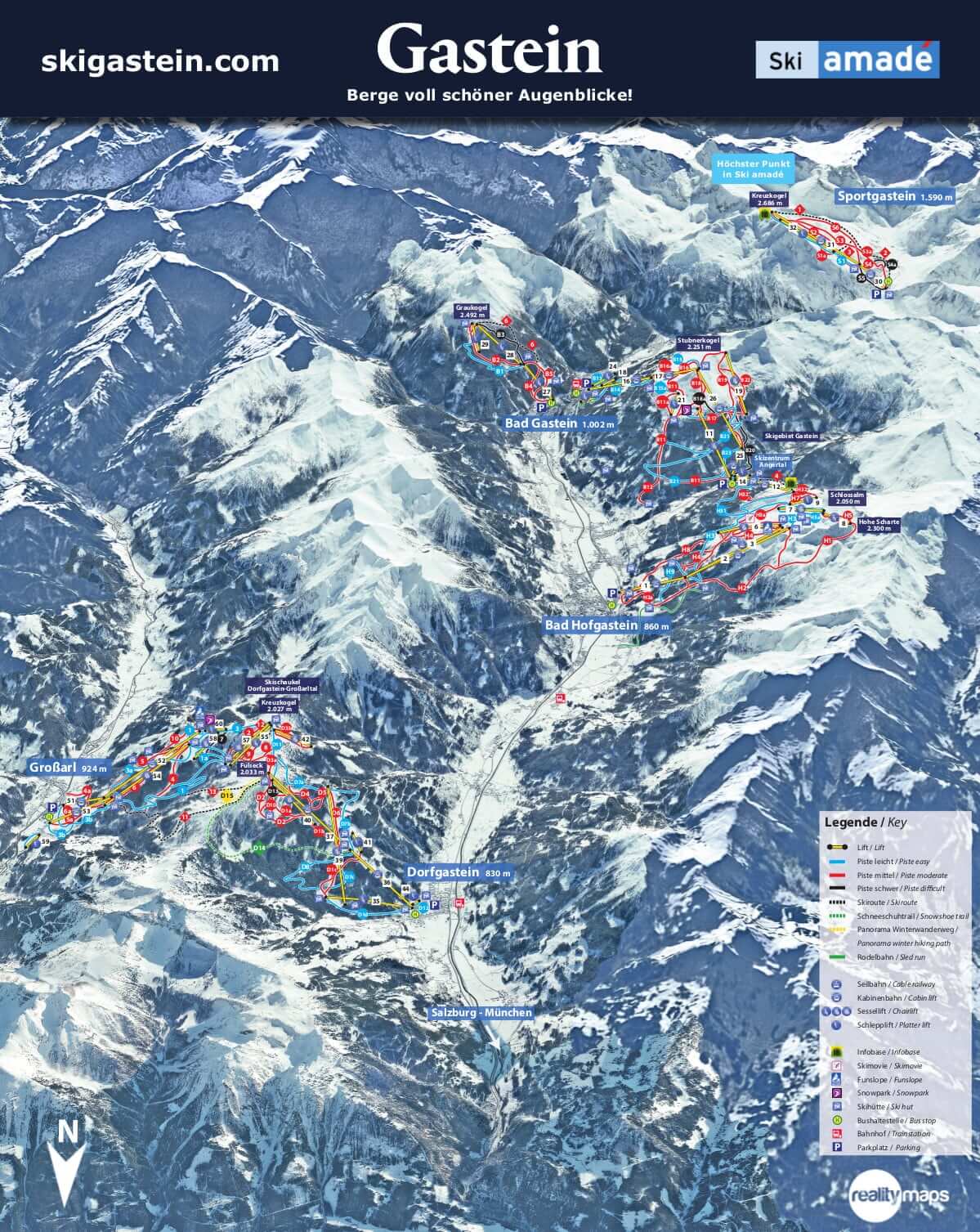
Terrain split: Gastein’s three ski areas aren’t lift-linked to one another, so the valley’s 180km of pistes are split across separate mountains rather than one connected network. Dorfgastein-Großarltal is the most beginner- and family-friendly of the three; Bad Hofgastein-Bad Gastein (Schlossalm-Angertal-Stubnerkogel) has the longest cruising runs and the most terrain overall; Sportgastein, the highest and smallest, is where the valley’s freeriders and ski tourers head.
Best for: intermediate cruisers, spa and wellness fans, families, couples wanting a mix of skiing and relaxation, and anyone who likes the idea of arriving by train rather than driving.
Not for: skiers who want one big lift-linked mountain, ski-in ski-out convenience in the historic centre, or those chasing the biggest vertical and glacier skiing in Austria; Gastein’s three ski areas are separate, linked only by road and ski bus.
Bad Gastein grew up around the Gastein Ache waterfall that still cuts through the centre of town, and around 17 natural hot springs that have drawn health tourists since the 16th century. Its Gasteiner Heilstollen, a former gold mine turned radon-therapy “healing gallery,” remains a genuine local institution, and the town’s grand, faded-glamour hotels are a legacy of an era when Bad Gastein hosted Habsburg emperors and composers (Schubert wrote his “Gasteiner” piano sonata here after a stay in the valley).
Skiing arrived later: Austria’s first cable car opened here in 1950, and Bad Gastein hosted the Alpine Skiing World Championships in 1958, cementing its place on the winter sports map. Today the valley’s three villages, Dorfgastein, Bad Hofgastein and Bad Gastein, each have their own character and their own direct rail station, but share a single lift-pass area and a free connecting ski bus network.
Learn more in our Resort Insider guide to Bad Gastein, and browse other options in our Austrian ski resorts hub.
The Gastein Valley’s skiing is split across three separate ski areas, all covered by one valley lift pass and connected by a free ski bus, but not linked to each other by lift:
Across all three areas, the valley offers around 180km of marked pistes, served by modern lift infrastructure, with the Stubnerkogel cable car linking directly to Bad Gastein’s train station and thermal spa.
Comparing options before you book? Our ski holiday deals and ski resort search tools make it easy to weigh up the Gastein Valley against other Ski Amadé bases.
Beginners are best served at Angertal (part of the Bad Hofgastein-Bad Gastein area) and at Dorfgastein-Großarltal, both of which have gentle practice slopes, dedicated ski schools and GASTI children’s parks.
Intermediates have the run of the valley: the long, wide panoramic pistes of Schlossalm and Stubnerkogel are built for confident carving, while Dorfgastein-Großarltal’s family line and funline add variety.
Advanced and expert skiers should head for “Die Nord” for the valley’s longest descent, and up to Sportgastein for genuine freeride terrain, ski touring routes and high-alpine bowls above 2,600m.
The Gastein season typically runs from late November to early May. Sportgastein’s altitude (up to 2,680m) gives it the most reliable late-season snow and sunny spring skiing conditions in the valley, while modern snowmaking helps protect the lower slopes of Dorfgastein and Schlossalm-Angertal earlier and later in the season. Early risers can also take advantage of dedicated early-morning skiing sessions on “Die Nord” before the lifts officially open to everyone else.
A Gastein Valley pass covers all three local ski areas and the connecting ski buses. Gastein is also part of Ski Amadé, one of Austria’s largest lift-pass alliances, which links five regions across Salzburg and Styria on a single pass, up to 760km of pistes and 260 lifts in total, so a Ski Amadé pass is worth considering if you plan to explore beyond the valley itself. The Gastein Card, included with many overnight stays, also adds discounts on thermal spas, cable cars and local events. Buy online in advance via the official ticket shop for the best rates and to avoid queues.
Each of the valley’s three villages has its own ski school offering lessons for all ages and abilities, with the Best Learn2Ski amadé quality standard applied across the wider Ski Amadé region. Family-focused instruction is concentrated at the GASTI Park locations in Dorfgastein, Angertal and Stubnerkogel. Ski and snowboard hire is available at shops in all three villages and at the main lift stations, so there’s no need to bring your own gear, though our ski gear guides are worth a look if you’re buying your own kit.
Bad Gastein itself is known for its grand, historic hotels built into the hillside around the waterfall, a distinctive, faded-grandeur look that sets it apart from most purpose-built Alpine resorts. Bad Hofgastein, the valley’s spa hub, has a wider range of modern 4-star wellness hotels built around its own thermal spa, the Alpentherme. Dorfgastein, the quietest and most traditional of the three, suits families and those after a lower-key base close to the family-friendly ski area. Across the valley, many hotels include the Gastein Card and spa access as standard.
Gastein’s mountain huts are a genuine highlight: the annual Gasteiner Skihauben Guide points skiers to seven mountain huts, each paired with one of Austria’s leading chefs for a signature dish, making a lunch stop as much a culinary event as a pit stop. In town, Ginger ‘n’ Gin is known for its enormous gin selection (over 100 varieties) alongside surprisingly good sushi, while Bad Hofgastein’s own Schmaranz microbrewery pours its beers in the cosy Bräustuberl. For something more traditional, look out for fondue nights and the Feng Shui-inspired UnterbergerWirt restaurant in Dorfgastein. After dark, the tiny Hexen Häusl bar on Bad Gastein’s Mozartplatz, decked out with Krampus masks and alpine folklore, is a local institution.
Bad Gastein’s thermal spas are the valley’s biggest non-ski draw: the Felsentherme in Bad Gastein and the Alpentherme in Bad Hofgastein both offer indoor and outdoor thermal pools fed by the valley’s mineral-rich springs, ideal for a post-ski soak with mountain views. The Gasteiner Heilstollen healing gallery offers radon inhalation therapy in a converted gold-mine tunnel, a genuinely unusual local experience. Families are well catered for with GASTI-branded children’s ski parks at three locations, winter hiking and snowshoe trails, cross-country skiing, and tobogganing runs across the valley. Planning a family trip? Our family skiing guide has more advice on choosing the right base.
Salzburg Airport is the closest, around 90 minutes from the valley by road, with regular UK flights and easy transfer or shuttle connections. Munich, Vienna and Innsbruck airports are all viable alternatives with good onward rail links. Bad Gastein’s own train station is one of the valley’s great advantages: it sits directly on the Tauern Railway mainline, with direct or easily-connecting services from Salzburg, Munich, Vienna, Innsbruck and Graz, and a footbridge leading straight from the platform to the Felsentherme spa and the Stubnerkogel cable car. Drivers should take the A10 Tauern Autobahn to the Bischofshofen exit; an Austrian motorway toll sticker (Vignette) and winter tyres are required.
Bad Gastein isn’t chasing the same crowd as Austria’s biggest lift-linked giants; its case rests on a genuinely different kind of ski trip, where thermal spas, grand old hotels and a historic spa-town atmosphere sit alongside three distinct, well-run ski areas. It particularly rewards travellers who value easy train access and a slower, more indulgent pace over maximum piste kilometres, and it’s an excellent option for mixed groups where not everyone wants to ski every day.
To some extent. Angertal and Dorfgastein-Großarltal both have dedicated beginner slopes and ski schools, but the valley overall is better suited to intermediates and above.
No. Dorfgastein-Großarltal, Bad Hofgastein-Bad Gastein and Sportgastein are three separate ski areas, connected by road and a free ski bus rather than by lift.
Ski Amadé is a large Austrian lift-pass alliance covering five regions across Salzburg and Styria, including Gastein, on a single pass, up to 760km of pistes and 260 lifts in total.
There’s no local airport, but Bad Gastein has its own mainline train station with direct or easily-connecting services from Salzburg, Munich, Vienna and Innsbruck airports.
A former gold-mining tunnel converted into a radon-therapy “healing gallery”, where guests lie underground for supervised sessions said to ease rheumatic and respiratory conditions, a genuinely unique Gastein experience.
Sportgastein, the highest of the valley’s three ski areas, rises to around 2,680m, the highest ski area in the whole Ski Amadé alliance.
Typically from late November to early May, with Sportgastein’s altitude extending reliable skiing furthest into spring.
Very much so; the valley’s thermal spas, healing gallery, winter hiking trails and grand-hotel spa culture make it one of the better Alpine resorts for mixed ski/non-ski groups.
“Die Nord”, in the Bad Hofgastein-Bad Gastein ski area, is the longest ski run in the whole of Salzburg province.
Not necessarily. Free ski buses connect the three villages and their ski areas, and Bad Gastein’s train station is within walking distance of the Stubnerkogel cable car and the Felsentherme spa.
Get all the latest ski news, gear reviews, snow reports and unmissable features direct to you inbox with our weekly ski update.