


Accommodation

Quick answer: Alta Badia suits families and mixed-ability groups looking for gentle, confidence-building terrain linked to one of the world’s largest lift networks, keen intermediates wanting to ski the Sella Ronda circuit, and travellers who rate exceptional mountain dining as highly as the skiing itself. It is less suited to dedicated experts chasing steep, technical terrain or those wanting a lively, late-night party scene.
Quick resort facts
Ski area: Alta Badia, 130km of local pistes linked into 1,200km via Dolomiti Superski, 54 lifts · Altitude: 1,324m at Pedraces, skiing up to 2,550m · Ski pass area: Dolomiti Superski · Nearest airport: Innsbruck (150km)
Written by the InTheSnow editorial team. Last updated: 29 July 2026. Resort facts checked against official Alta Badia sources.
Tucked into the upper reaches of the Val Badia in South Tyrol, Alta Badia is one of the most scenic and gastronomically celebrated corners of the Dolomites, a mountain range recognised by UNESCO for its extraordinary jagged limestone scenery. Centred on the villages of Corvara, Badia, La Val, San Cassiano and La Villa, the resort sits within the vast Dolomiti Superski network and forms part of the legendary Sella Ronda circuit, a day-long, lift-and-ski loop around the towering Sella massif that links four valleys. For UK skiers, Alta Badia is best suited to families, intermediates and food-focused travellers rather than committed experts: the skiing is gentle and immaculately groomed, the scenery is among the most dramatic in the Alps, and the mountain dining is some of the best found anywhere in the mountains.
Jump to: Ski Area · Skiing by Ability · Snow Reliability & Best Time to Go · Lift Passes · Getting There · FAQs
Best for: Families and mixed-ability groups who want gentle, well-groomed cruising terrain, intermediates keen to ski the Sella Ronda and explore several valleys on one pass, food-focused travellers who want serious mountain dining alongside their skiing, and skiers who value scenery, with some of the most dramatic peaks in the Alps. It is less suited to committed experts seeking steep couloirs, big mogul fields or extensive off-piste, anyone wanting a buzzing, late-night après-ski scene, or skiers on a tight budget, as Alta Badia sits at the premium end of Dolomite pricing. Some visitors will prefer the livelier edge of Val Gardena or Cortina d’Ampezzo, while others will happily trade that for Alta Badia’s calmer, more refined character.
Alta Badia is Ladin-speaking territory, giving the region a distinct culture, cuisine and identity that sets it apart from its German- and Italian-speaking Dolomite neighbours. It is a resort built around comfort and quality rather than scale for its own sake: the skiing is predominantly gentle and beautifully groomed, the villages are characterful, and the food scene is arguably the finest of any ski resort in the Alps.
Alta Badia itself offers around 130km of impeccably groomed pistes, served by 54 lifts, including 8 high-capacity gondolas and cableways, 29 chairlifts and 12 drag lifts. The local ski area runs from a base of 1,324m at Pedraces up to a lift-served summit of 2,550m on the Sella group, and the longest run from the top stretches 7.2km.
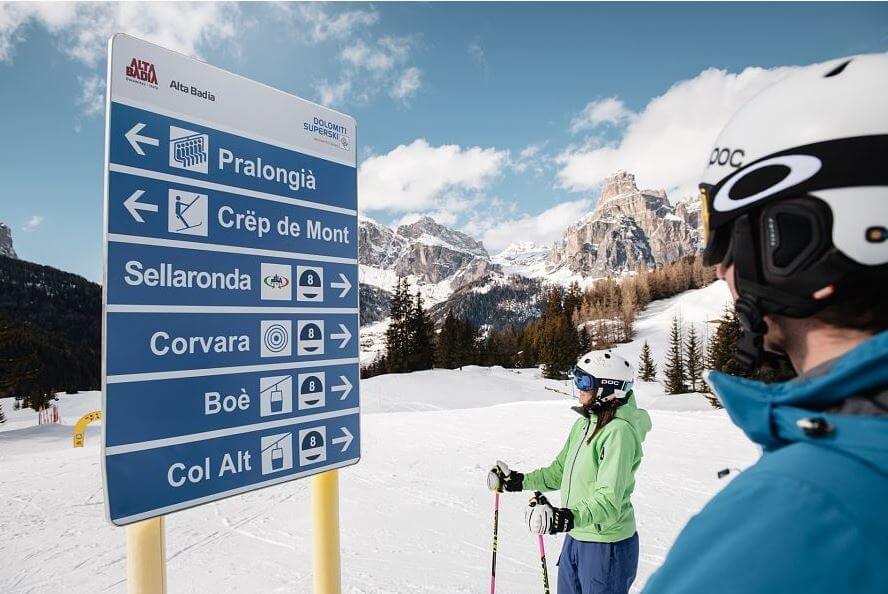
On its own, Alta Badia would already be a substantial resort, but its real drawing card is the connection into the wider Dolomiti Superski network: 12 valleys linked by a single lift pass, offering around 1,200km of pistes in total, one of the largest interconnected ski areas anywhere in the world. Val Gardena, Arabba and Val di Fassa are all reachable from Alta Badia’s lift system as part of the Sella Ronda loop, giving strong intermediates the chance to ski into an entirely different valley for lunch. Comparing options before you book? Our ski holiday deals and ski resort search tools make it easy to weigh up Alta Badia against other Dolomite bases like Val Gardena.
The piste mix is famously beginner and intermediate friendly, with roughly half the terrain classed as easy and another 40% intermediate, making Alta Badia a superb choice for families and confidence-building skiers. Wide, gentle pistes make Alta Badia perfect for beginners and families, with excellent nursery slopes and blue runs around Corvara and La Villa.
A large proportion of red runs gives intermediates a balanced mix of scenic cruising and more challenging descents, including much of the Sella Ronda circuit itself.
Don’t miss the Gran Risa, one of the most demanding World Cup giant slalom pistes on the circuit, dropping 448m from Col Alto to La Villa; otherwise, committed experts may find the terrain limiting compared with more extreme Alpine resorts, and the classic Gran Risa course above La Villa provides the sternest test for stronger skiers.
Alta Badia’s season typically runs from early December to early April. Altitudes here are more modest than the high-glacier resorts of the Alps, with the top lift reaching 2,550m, so natural snow cover can vary between seasons; the resort compensates with extensive snowmaking, covering around 80% of its pisted terrain, which keeps the main runs skiable even after a lean spell.
December and January bring the most reliably cold, consistent conditions, while February half-term is the busiest period on the Sella Ronda lifts. March and early April can deliver some of the best conditions of the season: long, sunny days combined with south-facing pistes that soften pleasantly by early afternoon, making Alta Badia a popular choice for spring skiing among Dolomite regulars.
Lift passes for Alta Badia are sold as part of the Dolomiti Superski pass, one of the best-value multi-day passes in the Alps given the sheer scale of terrain it unlocks. An adult day pass typically costs around €39, with a six-day pass around €205; child passes are priced at roughly €28 for a day and €144 for six days.
Because the pass covers all 12 valleys of the Dolomiti Superski area, it’s worth planning at least one or two days to explore beyond Alta Badia itself, whether that’s the Sella Ronda circuit or further afield to Cortina d’Ampezzo or the Val di Fassa.
Alta Badia has a strong network of ski schools across its villages, with instructors well used to teaching English-speaking visitors and a good choice of group and private lessons for all standards. Corvara, La Villa and San Cassiano all have dedicated ski school meeting points close to the main lifts, with gentle nursery slopes kept separate from the main pistes for beginners and children.
Ski and boot hire is widely available in every village, with shops generally offering good-quality demo equipment; booking online in advance is common practice and can save time and money during busy weeks. Our ski gear guides are worth a look if you’re buying your own kit.
Accommodation in Alta Badia leans towards comfortable, family-run hotels with a distinctly South Tyrolean warmth, spread across five villages rather than concentrated in one large resort centre.
Corvara is the largest and most central village, with the widest choice of hotels and easiest lift access, while San Cassiano and La Villa offer a quieter base with a slightly more exclusive feel.
Alta Badia is a genuine food destination as much as a ski resort. The “A Taste of Skiing” initiative sees well-known chefs design gourmet dishes exclusively for mountain huts each season, turning a lunch stop into an event in itself, and the resort holds more Michelin stars per capita than almost anywhere else in the Alps. Expect Ladin classics like canederli (bread dumplings), polenta and strudel alongside more refined mountain cuisine.
Après-ski here is relaxed and civilised rather than raucous: a glass of wine or a coffee on a sunny terrace is more typical than a lively bar crawl, and the resort’s reputation rests on quality dining rather than nightlife. Anyone hoping for a high-energy party scene should look elsewhere in the Alps.
Alta Badia’s gentle terrain and relaxed pace make it a genuinely good choice for families. Dedicated nursery slopes and childcare are available in the main villages, with gentle blue runs ideal for building confidence, and ski school meeting points in Corvara, La Villa and San Cassiano are kept close to easy terrain away from busier pistes.
Planning a family trip? Our family skiing guide has more advice on choosing the right base.
Alta Badia has plenty to offer off the slopes too.
The nearest airport to Alta Badia is Innsbruck, around 150km and roughly a two-and-a-half-hour transfer away, with regular flights from several UK airports. Verona and Venice are also commonly used by visitors, both a little further but well served by budget airlines, while Bolzano’s small regional airport is closer still for those with flexible travel plans.
Driving from the UK is a long but scenic option via Austria or Switzerland, and a car (or a good local bus network) is genuinely useful in Alta Badia given the resort is spread across several villages rather than a single centre.
Pros
Cons
Alta Badia is not a resort for skiers chasing extreme terrain or a wild nightlife, and it doesn’t pretend to be. What it offers instead is one of the most complete, comfortable Dolomite experiences available: gentle, beautifully groomed skiing for families and intermediates, direct access to the vast Sella Ronda and Dolomiti Superski network for those wanting to explore further afield, and a food scene that genuinely rivals the skiing as a reason to visit. For mixed-ability groups who want stunning scenery without excessive difficulty, it’s hard to beat.
Alta Badia itself has around 130km of pistes, but it connects directly into the Dolomiti Superski network, giving access to 1,200km of linked slopes across the wider Dolomites on a single lift pass.
The Sella Ronda is a famous circular ski route around the Sella massif that links Alta Badia with Val Gardena, Arabba/Marmolada and Val di Fassa, taking in four valleys and both clockwise and anticlockwise routes in a single day.
Yes. With a high proportion of blue and red runs and gentle, well-groomed slopes around Corvara and La Villa, Alta Badia is one of the more forgiving Dolomite resorts for beginners and families.
Alta Badia sits in Ladin-speaking territory, a distinct culture and language found in parts of the Dolomites, alongside German and Italian.
The Gran Risa above La Villa is the standout test for strong skiers, a steep World Cup giant slalom piste with a 448m vertical drop.
Yes. Alta Badia has an excellent range of snowshoeing trails, sleigh rides, spa hotels and mountain restaurants, making it a rewarding destination for anyone in the group who doesn’t ski.
Get all the latest ski news, gear reviews, snow reports and unmissable features direct to you inbox with our weekly ski update.