


Accommodation

Quick answer: Lake Louise suits scenery lovers, intermediates and advanced skiers wanting genuine variety across four mountain faces, and anyone wanting to combine skiing with one of the most photographed views in the Canadian Rockies. It is less suited to those chasing the deepest, most reliable powder in the Banff area, since Lake Louise sits slightly lower and drier than neighbouring Sunshine Village.
Quick resort facts
Ski area: Lake Louise, 282 pistes/145 trails, 10 lifts · Altitude: 1,646m base · Ski pass area: Ski Big 3 (Banff, Lake Louise, Sunshine) · Season: November to May · Nearest airport: Calgary (190km)
Best for: scenery lovers, intermediates and advanced skiers wanting genuine variety across four mountain faces, and anyone wanting to combine skiing with one of the most photographed views in Canada.
Not for: those chasing the deepest, most reliable powder in the Banff area. Lake Louise sits slightly lower and drier than neighbouring Sunshine Village.
Lake Louise Ski Resort is the largest single ski area of the Ski Big 3 resorts in Banff National Park, spread across four distinct mountain faces above the world-famous turquoise waters of Lake Louise and the historic Fairmont Chateau Lake Louise. It sits around 60km from Banff town and roughly 180km from Calgary along the Trans-Canada Highway. The resort has been operating since the 1950s, and its long-standing wildlife protection measures, including seasonal closures to protect grizzly bear habitat, reflect its location deep within a UNESCO World Heritage-listed national park.
Jump to: Ski Area · Skiing by Ability · Snow & Best Time to Go · Lift Passes · Getting There · FAQs
Few ski resorts anywhere match Lake Louise for sheer scenic drama, with sweeping views over the Bow Valley and surrounding glaciated peaks visible from much of the mountain, alongside a genuinely large and varied ski area. On a clear day, the view from the top of the gondola across the Bow Valley and towards Mount Temple is regularly rated among the best lift-served panoramas in North America.
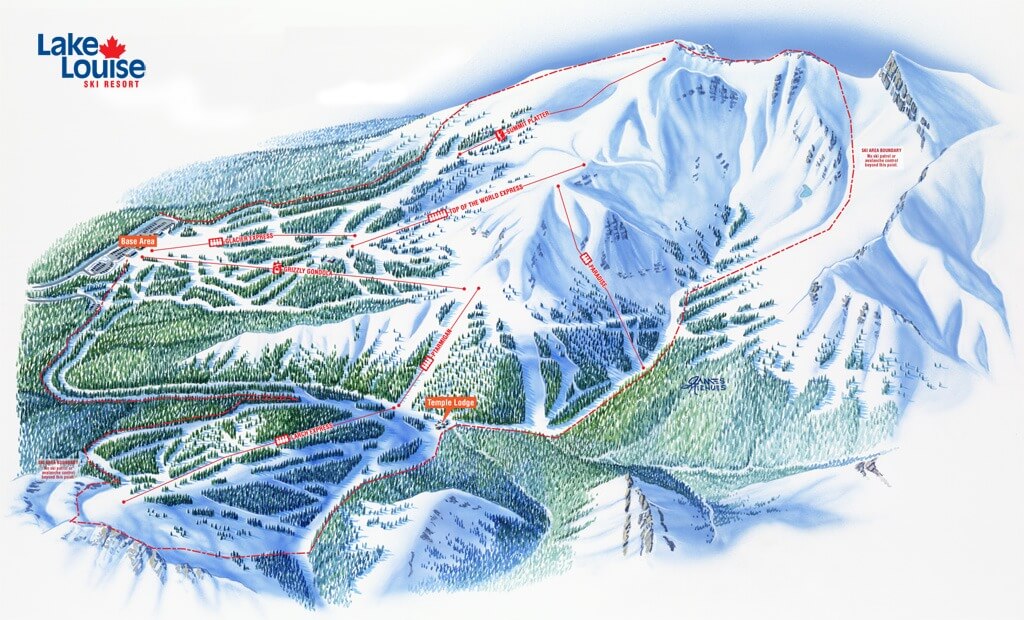
Lake Louise covers around 4,200 acres (17 sq km) across 145 trails, served by 10 lifts. The base sits at 1,646m (5,400ft), rising to 2,637m (8,650ft) at the summit, a vertical drop of 991m (3,250ft). The longest run stretches 8km (5 miles), and average annual snowfall is 454cm (180 inches). The resort’s relatively modest lift count belies its size, with each lift typically serving a large amount of varied terrain rather than a small, isolated pod of runs.
The resort is split across four distinct faces: the Front Side, with long groomed cruisers visible from the base; the Back Bowls, offering high alpine terrain above the treeline; Larch, known for excellent tree skiing and powder retention; and the Ptarmigan and Boomerang areas, which add further advanced terrain and genuine backcountry-style access. Moving between the four faces takes some planning given the resort’s size, and picking up a trail map or app at the base is genuinely useful for making the most of a day here.
The Front Side base area offers gentle, well-groomed learning terrain with some of the best mountain views of any beginner slope in Canada. Ski school meeting points sit close to the main day lodge, making it straightforward for families to get organised each morning.
The Front Side and Larch areas provide long, varied cruising runs, with Larch in particular offering excellent tree-lined intermediate terrain that holds snow well. Larch’s tree-lined runs are a particularly good option on stormy or flat-light days, when visibility on the more exposed Back Bowls can deteriorate quickly.
The Back Bowls and the Ptarmigan and Boomerang areas provide extensive above-treeline bowl skiing and steeper chutes, giving strong skiers genuine high-alpine terrain to explore. Hiking further along the ridge from the top of the Summit Platter opens up additional expert terrain for those willing to put in the extra effort.
Lake Louise averages 454cm (180 inches) of snow a year, somewhat less than neighbouring Sunshine Village, though the Larch area in particular holds snow well through the season. December through February bring the coldest, most consistent conditions, while March offers longer days and typically good cover on the upper mountain. Because Lake Louise sits slightly further from the Continental Divide than Sunshine Village, it can see marginally less snowfall, though its high proportion of north-facing terrain helps preserve snow quality well into spring.
Lake Louise is part of the Ski Big 3 lift ticket, alongside Banff Sunshine and Mount Norquay, and is also included on the Ikon Pass network. Booking online ahead of travel brings savings over walk-up prices. Multi-day Ski Big 3 tickets generally offer better value than buying single-day tickets for each resort separately, particularly for visitors planning to ski all three areas.
Lake Louise’s ski and snowboard school offers group and private lessons for all abilities, with rental equipment available at the base area and in nearby Banff and Lake Louise village. Specialist Back Bowl and off-piste clinics are also available for stronger skiers wanting to explore the resort’s high alpine terrain safely and confidently.
The historic Fairmont Chateau Lake Louise offers genuine slopeside grandeur beside the lake itself, while the small village of Lake Louise and nearby Banff town provide a wider range of accommodation for most budgets. Staying in Banff town is often more affordable than at the Chateau itself, with the Ski Big 3 shuttle bus providing a convenient link to Lake Louise each morning.
On-mountain dining includes several day lodges with genuinely spectacular views, while evening dining and après-ski are generally centred on Banff town or the Fairmont Chateau itself. A handful of restaurants in Lake Louise village offer a quieter, more low-key alternative to the busier options in Banff town itself.
Beyond skiing, visitors can ice skate on the frozen lake in front of the Chateau, snowshoe through the surrounding forest, or simply take in one of the most photographed views in the Canadian Rockies. The nearby Lake Louise Gondola, when running in winter, adds a further scenic, non-ski activity for visitors wanting a change of pace from downhill skiing.
Most UK visitors fly into Calgary International Airport and drive around two hours west along the Trans-Canada Highway, passing through Banff on the way to Lake Louise. A hire car offers valuable flexibility for visiting all three Ski Big 3 resorts and exploring the wider Banff National Park during a longer trip.
| Pros | Cons |
|---|---|
| Largest single ski area of the Banff-area resorts | Less natural snowfall than nearby Sunshine Village |
| Among the most scenic ski resorts anywhere in the world | Limited on-mountain nightlife and dining options |
| Genuine variety across four distinct mountain faces | Some backside terrain requires good visibility to enjoy fully |
| Historic Fairmont Chateau lakeside setting | Small village offers limited choice compared with Banff town |
Lake Louise pairs genuine scale with arguably the best scenery of any resort in the Canadian Rockies, spread across four genuinely different mountain faces above one of the most photographed lakes in the world. It receives a little less natural snow than Sunshine Village nearby, but the sheer variety of terrain, from gentle front-side cruising to high alpine bowls, makes it a highlight of any Ski Big 3 trip. For a first trip to the Canadian Rockies, it’s hard to imagine a more visually spectacular introduction to Ski Big 3 skiing than a day spent exploring Lake Louise’s four faces.
Yes, the Front Side base area offers gentle, well-groomed beginner terrain with some of the best mountain views of any learner slope in Canada.
Around 4,200 acres (17 sq km) across 145 trails, making it the largest single ski area among the Banff-area resorts.
Fly to Calgary International Airport, then drive around two hours west along the Trans-Canada Highway via Banff.
Lake Louise is part of the Ski Big 3 pass, alongside Banff Sunshine and Mount Norquay, and is also included on the Ikon Pass.
The resort averages around 454cm (180 inches) of snowfall a year, somewhat less than neighbouring Sunshine Village.
Get all the latest ski news, gear reviews, snow reports and unmissable features direct to you inbox with our weekly ski update.