Accommodation

Quick answer: Klosters suits those wanting a quieter, more discreet base than Davos while still accessing the same huge shared ski area, intermediate to advanced skiers thanks to a good mix of blue, red, black and freeride-marked runs, and anyone who values understated charm and traditional Swiss village character over big resort infrastructure. It is less suited to those wanting a lively nightlife scene, or budget travellers.
Quick resort facts
Ski area: Davos Klosters, 300km+ of pistes combined, 61 lifts · Altitude: 1,200m, skiing up to around 2,800m · Ski pass area: Davos / Klosters Top Card · Nearest airport: Zurich (150km)
Klosters is the quieter, more discreet twin to neighbouring Davos, sharing the same Parsenn ski area but keeping a distinctly low-key, picture-postcard character of its own. English visitors first arrived here in the 1860s, wooden skis followed from Norway in the 1880s, and some of the world’s first ski lifts went into operation nearby in the early 1930s – giving the Prättigau valley a genuine claim to be one of the birthplaces of Alpine skiing.
Unlike many resorts that have chased scale and visibility, Klosters has deliberately stayed small: a village of well under 4,000 residents spread across several hamlets, with most guest beds in private chalets rather than big hotels. It’s long been a favourite of the British Royal Family – King Charles III has skied here for decades, and the main cable car up to Gotschnagrat was renamed in his honour in 2023 – yet it remains refreshingly unpretentious given its glamorous following.
Jump to: Ski Area · Skiing by Ability · Snow & Best Time to Go · Lift Passes · Getting There · FAQs
Terrain split: shares the full Parsenn/Davos Klosters network, with a genuine mix of blue, red, black and marked freeride terrain, plus its own local Madrisa sector for gentler, family-friendly skiing.
Best for: those wanting a quieter, more discreet base than Davos while still accessing the same huge shared ski area; intermediate to advanced skiers, thanks to a good mix of blue, red, black and freeride-marked runs; anyone who values understated charm and traditional Swiss village character over big resort infrastructure.
Not for: those wanting a lively nightlife scene or big resort buzz – that’s better found in Davos Platz, just down the valley; budget travellers, as Klosters’ quiet exclusivity comes with a price tag to match.
Klosters sits in the Prättigau valley and splits into two parts: Klosters Platz, the livelier centre with most of the hotels, bars, restaurants and shops, plus the cable car link towards Davos; and Klosters Dorf, the quieter option, with its own gondola up to the Madrisa ski area and a free bus service connecting the two. Despite its low profile, Klosters has quietly hosted a remarkable roll call of visitors over the decades, from Hollywood stars of the mid-20th century to the British Royal Family today.
The resort’s first hotel opened its doors to winter visitors in 1904, and rather than expanding aggressively, Klosters has focused on preserving its Alpine architecture and controlled growth, relying on its lift link to Davos to provide access to a genuinely world-class ski area without the need to build one of its own from scratch.
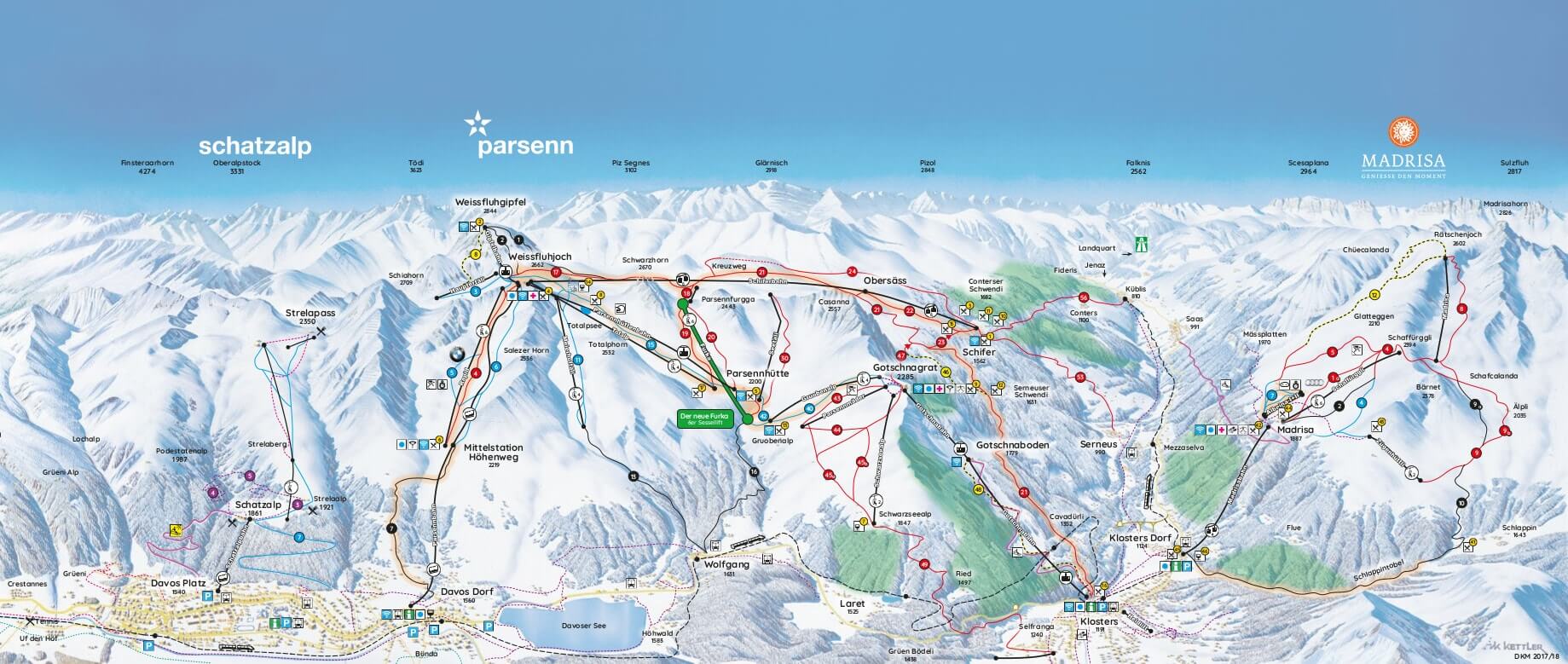
Klosters shares its ski area with Davos, giving access to the full Parsenn network and beyond – more than 300km of pistes when combined. Unlike many large ski areas that favour endless intermediate cruising, this one offers genuine challenges for all ability levels, with a full mix of blue, red, black and marked freeride terrain. Locally, Klosters Dorf has its own gentler sector at Madrisa, reached by gondola, which suits families and less confident skiers well.
The main cable car from Klosters Platz climbs to Gotschnagrat at 2,281m, linking directly into the wider Davos ski area and giving quick access to some of the best long cruising runs in the Alps. Comparing options before you book? Our ski holiday deals and ski resort search tools make it easy to weigh up Klosters against other Swiss bases.
Beginners and families are well served by the Madrisa sector above Klosters Dorf, which offers gentler terrain away from the busier Parsenn runs. Intermediates have huge scope across the shared Davos Klosters network, with long, well-groomed runs linking back down towards the village.
Advanced skiers will find plenty to test them too, including black runs and marked freeride terrain across the wider ski area – a genuine point of difference from resorts where the terrain skews heavily towards easy cruising.
Klosters sits at around 1,200m, with the shared ski area reaching well over 2,800m, giving good snow reliability across the season and particularly strong conditions higher up. January and February typically offer the coldest, most reliable snow, while the resort’s high-altitude terrain holds conditions well into March.
Klosters is covered by the same Davos Klosters Mountains pass as Davos, giving access to the full shared ski area across all six connected sectors, including Parsenn, Madrisa, Jakobshorn, Rinerhorn, Pischa and Schatzalp.
Klosters has its own well-regarded ski schools offering lessons for all ages and abilities, with particularly strong beginner options at Madrisa, and several hire shops in both Platz and Dorf covering the full range of equipment needs. Our ski gear guides are worth a look if you’re buying your own kit.
Much of Klosters’ accommodation is in private chalets, many occupied for the whole winter season, alongside a range of traditional hotels concentrated mainly in Klosters Platz. The overall feel is understated and discreet rather than flashy, in keeping with the resort’s long-standing reputation as a low-key retreat for those wanting genuine escapism.
Klosters Platz has most of the resort’s restaurants, bars and shops, with a relaxed, sociable atmosphere rather than a big party scene. Traditional Swiss dining is easy to find throughout the village, and the historic Hotel Chesa Grischuna has long been one of the resort’s most storied places to eat and drink.
Families are well catered for at the gentler Madrisa sector above Klosters Dorf, and the resort’s quiet, traditional village character makes it an easy place to unwind away from the piste. A free bus service connects Klosters Platz and Dorf, and the wider Davos Klosters area offers extensive winter walking, cross-country trails and wellness options. Planning a family trip? Our family skiing guide has more advice on choosing the right base.
Klosters lies around 150km from Zurich, the nearest international airport. By train, take a direct connection from Zurich to Landquart, then a regional train onward to Klosters Platz or Klosters Dorf. Drivers should allow a similar journey time to Davos, at around 2.5 hours from Zurich.
Klosters is the resort for skiers who want the scale and quality of the Davos Klosters ski area without the busier, more urban feel of Davos itself. Quiet, understated and steeped in ski history, it’s a superb choice for those who value genuine Alpine character and a touch of discreet exclusivity alongside serious, varied terrain.
Klosters is smaller, quieter and more traditional in character, while Davos is a larger, more urban town with livelier après-ski – both share the same lift pass and ski area.
King Charles III has skied in Klosters for decades and Princes William and Harry learned to ski there; the main cable car to Gotschnagrat was renamed in the King’s honour in 2023.
Yes, the Madrisa sector above Klosters Dorf offers gentler terrain well suited to beginners and families, away from the busier Parsenn runs.
Klosters Platz is the livelier centre with most hotels, bars and shops, plus the cable car towards Davos, while Klosters Dorf is quieter, with its own gondola up to the Madrisa ski area.
Fly into Zurich, then take a train to Landquart followed by a regional train to Klosters Platz or Klosters Dorf; the whole journey takes around 2.5 hours.
Get all the latest ski news, gear reviews, snow reports and unmissable features direct to you inbox with our weekly ski update.