
It’s the age old question, how snowy will next winter be? And the truth as we all really know in our heart of hearts, and from many years of experience, is that no one really knows.
Of course lots of people will tell you they know, quite a few people and companies even make a business out of it – they use every technique they can from ancient signs and symbols passed down through the generations to the latest hi tec computer mapping.
I don’t know if anyone has ever done a study of how often the forecasts were correct, or whether the ultra-modern or old fashioned techniques are more likely to be correct, but I do believe, correctly or otherwise, that in late summer or early autumn each year British newspapers invariably forecast a harsh winter. I’m not sure if they ever print retractions when proved wrong by lacklustre, mild winters.
Then there’s Murphy’s Law or ‘chaos theory’ which are again old and new ways of saying that whatever we think might happen, other things happen, sometimes with great irony, and that whatever evidence we try to use, random factors might cause a different result.
And then there’s also the law of averages. Autumn 2014 was exceptionally warm and dry so does that mean that this autumn will be cold and snowy to balance it out? The early signs have been good but does that mean it will continue and get snowier? Who really knows?
And we better not even get started on the possible effects of climate change…
Are we in for Snowmageddon?
But this year there’s a big story behind the snow projections which the tabloids are forecasting as a kind of ‘snowmageddon’ for British suburbs, inadvertently raising the spirits of skiers and boarders in the process.
![[SNOWHUNTER] How Snowy Will This Winter Be ?](https://www.inthesnow.com/wp-content/uploads/2015/10/url.jpg)
It’s called the ‘El Niño Effect’ and its happening in the Pacific Ocean.
![[SNOWHUNTER] How Snowy Will This Winter Be ?](https://www.inthesnow.com/wp-content/uploads/2015/10/650x366_10091538_2015-europe-winter-highlights1.jpg)
“…El Niño is the warm phase of the El Niño Southern Oscillation (commonly called ENSO) and is associated with a band of warm ocean water that develops in the central and east-central equatorial Pacific (between approximately the International Date Line and 120°W)….” Google infors me.
What that translates to is usually a shed load of precipitation that hits the west coast of North America, particularly the Californian end of the US and leads to heavy snowfall. Hopefully.
![[SNOWHUNTER] How Snowy Will This Winter Be ?](https://www.inthesnow.com/wp-content/uploads/2015/10/url.png)
There’s been a drought there for four years now and there have been some fairly lousy ski seasons so the news of “a probable La Niña event” is causing some excitement.
To be fair it isn’t unbridled excitement because around this time of year whether it’s an El Niño event, or the alternative La Niña, ski resorts tend to say it means a snowy winter is coming, and obviously that’s not been the case for the past four winters.
But this time the weather forecasters have got a bit excited. They’re forecasting a ‘very strong El Niño’ which should mean lots of snow. How strong depends on which media outlet you read. It started with the strongest for 10 years, then 20 years and eventually 65 years – or “since 1950.” One site I’ve seen went for “the strongest El Niño ever recorded” which may be the same thing.
So if you’ve booked a ski trip to the Western US things are potentially looking god – assuming airports aren’t closed, roads blocked and lifts buried by this cataclysmic snowy deluge.
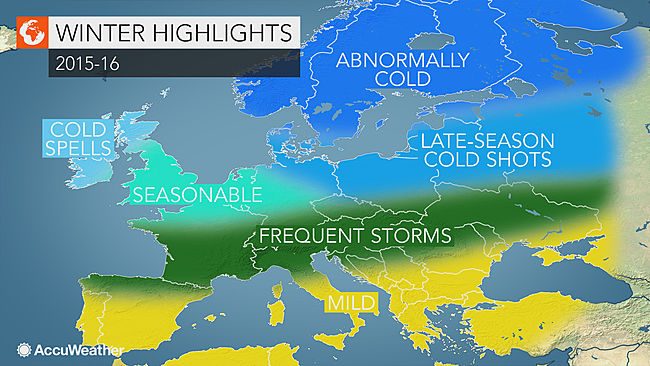
But what does this mean for Europe and the Alps?
Well it depends on who you want to believe. Quite a few commentators in North America say that El Niño has no effect on the eastern half of North America let alone stretching its snowy tentacles further East across the Atlantic and certainly last winter, whilst western North America stayed dry, the east had totally different weather, some ski centres setting snowfall records in fact.
But again UK newspapers have none-the-less translated the El Niño effect on Western North America as leading to identical heavy snowfall in Western Europe.
![[SNOWHUNTER] How Snowy Will This Winter Be ?](https://www.inthesnow.com/wp-content/uploads/2015/10/url3.jpg)
Is that realistic? Well probably not, but the Met Office have sad that the last ‘strong’ El Niño five years ago did coincide with one of the coldest, snowiest years in recent history and certainly this century in the UK – 2010.
But they also say that they’re not sure if that’s coincidence or if there really is a direct correlation. They also say that if this winter’s El Niño is as strong as forecast and if there is a correlation there might be a different result over here from a strong El Niño over there.
Which brings us back to “nobody really knows.” The same as every year.
So what do we know?
Well there has been several feet of snow on high slopes in the Alps, so if you’d been in Fee in Switzerland on the right days in September or earlier this month you could have skied some late summer or autumn powder, that’s got to be a good sign, so long as it stays cold.
![[SNOWHUNTER] How Snowy Will This Winter Be ?](data:image/svg+xml;base64,PHN2ZyB2aWV3Qm94PSIwIDAgNDgwIDI4OCIgd2lkdGg9IjQ4MCIgaGVpZ2h0PSIyODgiIHhtbG5zPSJodHRwOi8vd3d3LnczLm9yZy8yMDAwL3N2ZyI+PC9zdmc+)
Scandinavia, which did have a good winter last year, is looking good so far too, Ruka in Finland opened early as it was cold enough for snowmaking back on 12th October.
So all the signs, for what they’re worth, are good. We just have to hope the tabloids are right.
![[SNOWHUNTER] How Snowy Will This Winter Be ?](https://www.inthesnow.com/wp-content/uploads/2015/10/url2.jpg)