
Accommodation

Quick answer: Nozawa Onsen suits travellers wanting a genuine, historic Japanese ski village rather than a purpose-built resort, skiers and snowboarders who value a large, varied mountain with lifts fanning out in all directions, and anyone keen to combine skiing with soaking in traditional hot spring baths. It is less suited to those wanting slick, modern resort infrastructure or an English-first experience.
Quick resort facts
Ski area: around 54km of piste, 21 lifts · Altitude: base 565m · Region: Nagano (Shinetsu) · Nearest airport: Tokyo · Season: mid-November to early May
Nozawa Onsen is one of Japan’s oldest and most storied ski villages, built around a genuine working hot spring town in Nagano Prefecture rather than a purpose-built resort development. Narrow streets, traditional wooden buildings and 13 free public soto-yu bath houses give it an atmosphere unlike almost anywhere else in Japanese skiing. Wandering between the different soto-yu bath houses, each with its own character and regulars, is as much a part of a Nozawa Onsen stay as the skiing itself.
The resort’s skiing history runs deep: Austrian ski pioneer Hannes Schneider, of Arlberg fame, taught here in the 1930s, helping cement Nozawa Onsen’s place as one of the birthplaces of Japanese alpine skiing. Today lifts fan out from the village in multiple directions across a large, varied mountain, and the town’s dramatic Dosojin Fire Festival each January is one of the highlights of the Japanese ski calendar.
Jump to: Ski Area · Skiing by Ability · Snow Reliability · Lift Passes · Getting There · FAQs
Terrain split: gentle runs near the village base for beginners; broad, varied cruising across the upper mountain for intermediates; steeper pitches and tree skiing higher up for advanced skiers.
Best for: travellers wanting a genuine, historic Japanese ski village; skiers and snowboarders wanting a large, varied mountain with terrain fanning out in multiple directions; anyone keen to combine skiing with traditional onsen hot spring bathing.
Not for: those wanting slick, purpose-built modern resort infrastructure; visitors who prefer an English-first experience, as Nozawa Onsen remains proudly, authentically Japanese in character.
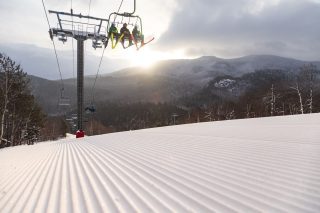
Nozawa Onsen’s ski area covers around 54km of piste served by 21 lifts, with runs fanning out from the historic village in several directions across a genuinely large mountain by Japanese standards. The layout rewards exploration, with a good mix of open cruising terrain and narrower, tree-lined runs. Because runs fan out in several directions from the village, checking which sectors are open and well-groomed on a given morning is worthwhile, particularly after a fresh overnight snowfall.
The resort’s deep skiing heritage, dating back to Austrian instruction in the 1930s, is still visible in its well-established piste network and long-serving lift infrastructure, giving Nozawa Onsen a genuine sense of history rarely found at newer Japanese ski developments.
Beginners have gentle, dedicated terrain close to the village base, making it easy to build confidence before venturing further up the mountain. Intermediates will find broad, varied cruising across the upper slopes, with enough terrain diversity to avoid repetition over a full week.
Advanced skiers can find steeper pitches and satisfying tree skiing higher on the mountain, particularly after a fresh snowfall, giving the resort a good spread of challenge alongside its family-friendly lower slopes.
Nozawa Onsen’s Nagano location brings consistent snowfall through the winter, benefiting from the same weather patterns that make the wider Shinetsu region a reliable snow zone. The season runs from mid-November to early May, with January and February typically offering the most consistent snow conditions, and the Dosojin Fire Festival in mid-January adding a memorable cultural highlight to a winter visit. Nagano’s continental climate, sitting slightly inland from the coast, tends to produce drier, lighter snow than some of Japan’s more famously deep coastal resorts, though falls remain frequent through the core winter months.
Lift passes are competitively priced, with adult day passes typically from around ¥4,800 and child day passes from around ¥2,200. Multi-day tickets are available and represent good value given the size of the ski area. Multi-day and season passes offer noticeably better value than single-day tickets, particularly for visitors staying close to a week in the village.
Ski and snowboard schools operate from the base area, with some English-language instruction available, reflecting the resort’s long ski-teaching heritage dating back to Hannes Schneider’s Arlberg-style instruction in the 1930s. Rental shops throughout the village cover equipment for all levels, from complete beginners to skiers wanting to explore the upper mountain’s tree runs.
Accommodation is spread through the traditional village, ranging from historic Japanese ryokan inns to modern hotels and guesthouses, many with their own onsen baths fed by the town’s natural hot springs. Staying in the village itself, rather than at a standalone lift-base hotel, is part of the authentic Nozawa Onsen experience. Booking well ahead is advisable during the Japanese New Year and Chinese New Year periods, when domestic and international demand both peak sharply.
With around 25 restaurants across the village, dining leans heavily towards authentic Japanese cuisine, including the region’s noted soba noodles and sake. Evenings are generally spent soaking in one of the village’s 13 free public soto-yu hot spring baths rather than at a Western-style bar scene, giving Nozawa Onsen a distinctly relaxed, traditional feel after dark. Small izakaya-style bars and cafes around the village add a low-key alternative to the hot spring baths for those wanting a quieter evening.
Nozawa Onsen’s gentle beginner terrain and traditional village setting make it a rewarding choice for families wanting an authentic cultural experience alongside their skiing. The town’s free public hot spring baths are a highlight for all ages, and visiting during the Dosojin Fire Festival in mid-January offers a memorable, once-a-year cultural spectacle.
Fly into Tokyo, then take the Hokuriku Shinkansen to Iiyama Station, followed by a bus transfer of around 25 minutes to reach the village. The Shinkansen link makes Nozawa Onsen a relatively straightforward Nagano-region resort to reach from Tokyo without a hire car. A hire car is rarely necessary given the efficient rail and bus connections, though it does offer flexibility for exploring the wider Nagano region on a longer trip.
Nozawa Onsen offers one of the most authentic ski village experiences in Japan, pairing a genuinely large, varied mountain with a historic hot spring town rather than a manufactured resort bubble. It asks a little more of visitors unfamiliar with Japanese customs and language, but for culture, history and a satisfying day’s skiing followed by an evening soak, it’s hard to match. Its combination of genuine ski heritage, an enormous fanned-out mountain and nightly onsen soaking makes Nozawa Onsen one of the most memorable resorts covered in this guide.
Nozawa Onsen covers around 54km of piste across 21 lifts, with runs fanning out from the village in several directions.
It’s one of Japan’s oldest ski villages, known for its free public hot spring baths, historic ski-teaching heritage dating to the 1930s, and its annual Dosojin Fire Festival each January.
Take the Hokuriku Shinkansen from Tokyo to Iiyama Station, then a bus transfer of around 25 minutes to reach the village.
Yes, the village has 13 free public soto-yu hot spring baths fed by natural onsen water, a highlight for visitors after a day’s skiing.
Get all the latest ski news, gear reviews, snow reports and unmissable features direct to you inbox with our weekly ski update.